The main types of pricing strategies, from penetration and skimming to membership, bundle and decoy pricing, grouped by goal with a real company example for each.
A pricing strategy is the method a company uses to set and change prices to reach a goal. The main types are penetration, skimming, value-based, premium, dynamic, loss leader, razor and blade, membership, bundle, decoy and transparent pricing.
Each one is filed in Read Startup’s pricing case studies with the real companies that used it. This page is the map: what each strategy is, when it fits, and one company that ran it.
What is a pricing strategy?
A pricing strategy is the method a company uses to set and change prices based on costs, customer value, competition and a goal such as market share or margin.
It is different from a pricing model. The strategy decides the price level and how it changes over time; the model decides how the customer is charged, such as per unit, by subscription or by usage. A company can keep the same model, say a monthly subscription, and switch strategy, say from a low launch price to a premium one.
Four inputs shape every pricing strategy: what it costs to serve a customer, what the customer gains, what rivals charge, and what the company is trying to achieve. Pricing from cost alone ignores three of them.
What are the main types of pricing strategies?
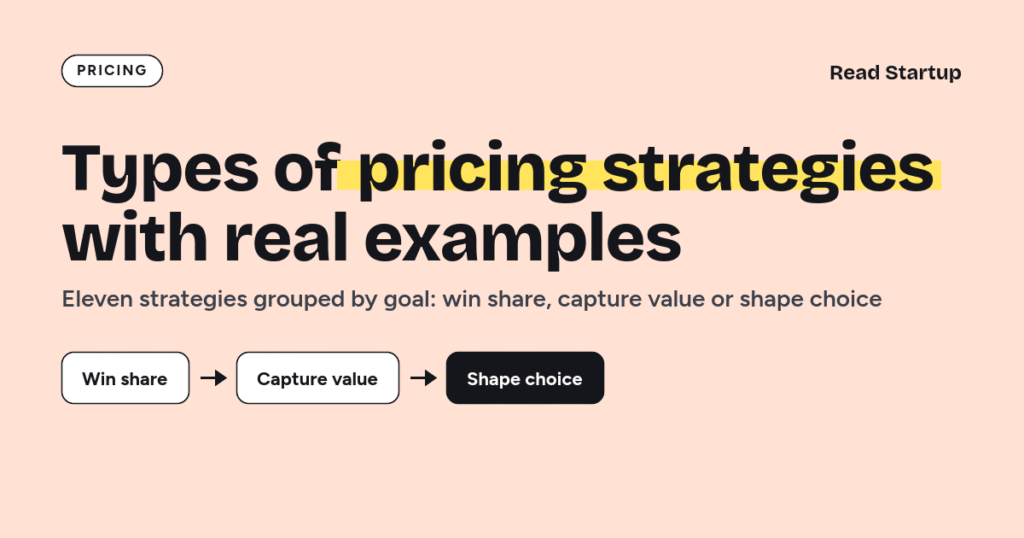
The eleven main types are penetration, skimming, value-based, premium, dynamic, loss leader, razor and blade, membership, bundle, decoy and transparent pricing, grouped by whether they win share, capture value or shape choice.
Strategies that win share
Penetration pricing
Penetration pricing launches below rivals, sometimes free, to win market share fast, then earns once customers are in. It only works with a planned exit such as scale or lock-in. See our penetration pricing examples.
Loss leader pricing
Loss leader pricing sells a few items below cost to bring customers in, betting they will buy higher-margin items on the same trip. It needs a reliable basket of other purchases. See loss leader pricing examples.
Razor and blade
Razor and blade pricing sells the base product cheaply and earns on refills or consumables that only fit it. It depends on customers being unable to buy cheaper refills elsewhere. See razor and blade examples.
Transparent pricing
Transparent pricing shows the full cost upfront, including fees rivals hide, and uses that honesty as the way to win customers from incumbents. See transparent pricing examples.
Strategies that capture value
Price skimming
Price skimming launches high for early adopters who want the product most, then cuts the price to reach the wider market. It suits new products with few substitutes. See price skimming examples.
Value-based pricing
Value-based pricing sets the price from what the customer gains, measured with a value metric such as seats, transactions or usage, so revenue grows with the customer. See value-based pricing examples.
Premium pricing
Premium pricing holds prices above rivals on purpose, so the price itself signals quality. It breaks the moment the brand starts discounting. See premium pricing examples.
Dynamic pricing
Dynamic pricing changes prices in real time with demand, time or supply, as with surge fares or airline seats. It captures peak demand but can anger customers who notice. See dynamic pricing examples.
Membership pricing
Membership pricing charges a recurring fee for access, often to lower prices, so members concentrate their spending with you. The fee has to cover your heaviest users. See our membership pricing examples.
Strategies that shape choice
Bundle pricing
Bundle pricing sells several products together for one price, below the sum of their separate prices, which moves customers toward buying more. See bundle pricing examples.
Decoy pricing
Decoy pricing adds an option few people will choose, so another option looks like better value next to it. It changes which option customers pick, not the prices themselves. See decoy pricing examples.
How do you choose a pricing strategy?
Match the strategy to your goal and cost structure: penetration when share matters and scale lowers cost, skimming when the product is new and unique, value-based when customers can measure the gain, dynamic when demand swings.
| Strategy | Goal | Best when | Main risk |
|---|---|---|---|
| Penetration | Win share | Scale or lock-in lowers cost later | Customers anchor on the low launch price |
| Skimming | Capture early value | Product is new with few substitutes | Early buyers resent fast price cuts |
| Value-based | Capture value | Customers can measure what they gain | Wrong value metric drives churn |
| Dynamic | Match demand | Demand swings by time or place | Backlash when customers notice |
| Membership | Loyalty and recurring revenue | Members use it often and cheaply | Heavy users cost more than the fee |
| Decoy | Shape choice | You have two or three plans | Looks manipulative if obvious |
Your cost structure narrows the list before your goal does. If serving one more customer costs almost nothing, penetration, membership and bundles are open to you. If every sale carries real cost, value-based or premium pricing protects margin. A full one-page comparison is coming as our pricing strategy cheat sheet.
Which real companies used each pricing strategy?
Jio launched with free data (penetration), Apple cut the 8GB iPhone from $599 to $399 in 2007 (skimming), Costco charges a membership fee, Gillette sells handles cheaply and earns on blades, and The Economist’s offer became the classic decoy example.
| Strategy | Company | Decision | Source |
|---|---|---|---|
| Penetration | Reliance Jio | Free 4G voice and data from September 2016 | RIL media release, 21 Feb 2017 |
| Skimming | Apple iPhone | 8GB model cut from $599 to $399 on 5 September 2007 | CNN Money, Sept 2007 |
| Membership | Costco | Annual fee on top of low markups | Costco FY2025 10-K |
| Razor and blade | Gillette | Cheap handles, recurring blade sales | Company model |
| Decoy | The Economist offer | $59 web, $125 print, $125 print + web | Dan Ariely, Predictably Irrational (2008) |
| Transparent | Wise | Shows its fee and exchange rate upfront | Company model |
Reliance Jio. Free launch pricing put 100 million subscribers on the network in 170 days, according to Reliance Industries’ release of 21 February 2017. Read about Jio’s free-data launch.
Apple. Apple launched the iPhone in June 2007 and cut the 8GB model from $599 to $399 on 5 September 2007, about ten weeks later. Early buyers paid for being first; the lower price opened the wider market.
Costco. Costco keeps markups low and earns a large share of its income from fees: its renewal rate was 92.3% in the US and Canada in fiscal 2025, per its 10-K.
The Economist decoy. In an experiment Dan Ariely ran with MIT students, adding a print-only option at the same $125 as print + web raised the share choosing print + web from 32% to 84%. The Economist test was run by Dan Ariely with MIT students, not on live subscribers.
What pricing strategy mistakes should you avoid?
Avoid pricing from cost alone, copying a rival’s price without its cost base, discounting a premium brand, and launching low with no plan for raising prices later.
- Pricing from cost alone. Cost-plus pricing ignores what customers will pay, so it leaves money behind when value is high and loses sales when it is low.
- Copying a rival’s price without its cost base. A rival with lower costs can live on a price that bankrupts you.
- Discounting a premium brand. Discounting erodes premium positioning faster than it brings in new buyers.
- Launching low with no plan to raise prices. Without an exit lever, a low price becomes a permanent discount.
Frequently asked questions about pricing strategies
What are the 4 main pricing strategies?
Textbooks usually list four: penetration pricing, price skimming, competitive pricing and value-based pricing. In practice, companies also use premium, dynamic, membership, bundle, loss leader, razor and blade, decoy and transparent pricing, which is why this page groups eleven types by goal.
What is the most common pricing strategy?
Cost-plus pricing, adding a markup to cost, is the most common in practice because it is simple. It is also the weakest, because it ignores what customers will pay and what rivals charge.
What pricing strategy should a startup use?
It depends on your cost structure and goal. If serving one more customer costs almost nothing and share compounds, penetration or freemium can work, but only with a planned exit. If each sale carries real cost, start with value-based pricing so revenue grows with the value you deliver.
What is the difference between pricing strategy and pricing model?
A pricing strategy decides the price level and how it changes; a pricing model decides how the customer is charged, such as per unit, subscription or usage. You can change one without changing the other.
How often should you change prices?
Review prices at least once a year and whenever costs, rivals or your product change materially. Test a change on one group of customers before rolling it out, and tell existing customers early.
Pick the strategy that fits your goal, then read the companies that ran it in our pricing case studies. To get one company decision broken down twice a week, subscribe free.
By the Readstartup Team. Figures are attributed to the filing, release or book they come from and dated; corrections are logged on our Corrections Policy page.
More guides
Transparent Pricing Examples: Companies That Won by Exposing Hidden Fees
Transparent pricing examples from Wise, Southwest Airlines and Costco: how showing the real price beat rivals who relied on hidden fees, and what it…
Premium Pricing Examples
Premium pricing examples from Hermès, Apple, Liquid Death and Patagonia: how brands hold high prices permanently, and what keeps a premium from collapsing into…
Decoy Pricing Examples
Decoy pricing examples from The Economist experiment, cup sizes, popcorn and SaaS pricing pages: how a third option steers choice, and how to tell…