Transparent pricing examples from Wise, Southwest Airlines and Costco: how showing the real price beat rivals who relied on hidden fees, and what it costs to keep the promise.
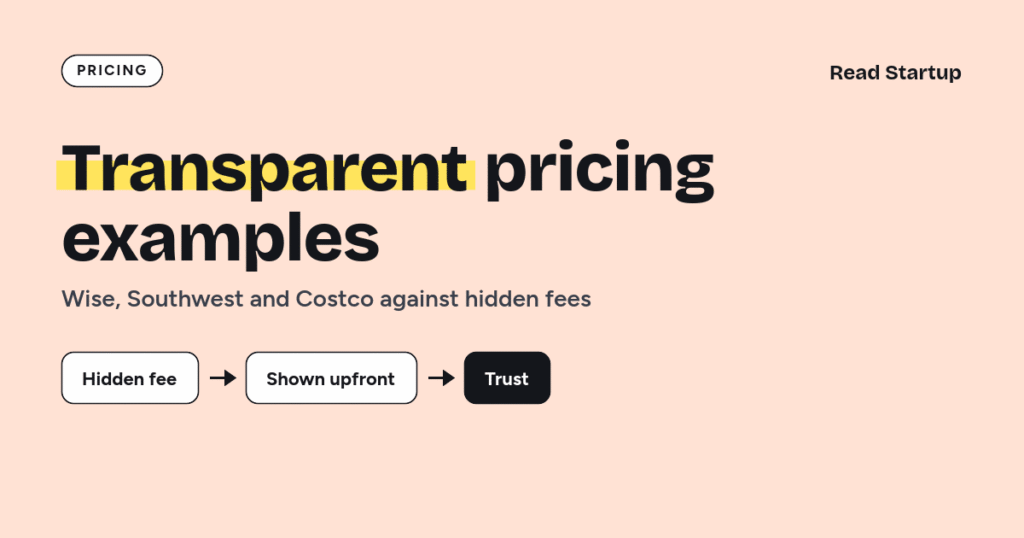
Transparent pricing shows customers exactly what they pay and why. Wise built a business by showing the exchange-rate markup banks hid, Southwest kept “bags fly free” for decades while rivals added fees, and Costco reportedly caps its markups.
This page is part of Read Startup’s pricing case studies and one of the types of pricing strategies. It covers why openness works as a competitive weapon, why incumbents cannot copy it, and what it costs to keep.
What is transparent pricing?
Transparent pricing is a strategy of showing the full price, including fees and markups, upfront and often comparing it with competitors. It wins trust in markets where hidden fees are common.
In most markets transparency is just good manners. It becomes a strategy in markets where the leaders earn a large part of their money from fees customers do not see: exchange-rate spreads, baggage charges, add-ons at checkout. There, simply showing the real number is an attack on the incumbents’ business model.
How does transparent pricing work as a strategy?
Transparency works as positioning: if competitors depend on hidden fees, they cannot match openness without losing revenue, so the transparent company gains an edge that lasts as long as its costs allow.
- Exposing the competitor’s hidden fee. The message is not “we are cheap” but “here is what the others charge you without saying”.
- Making the comparison easy. Showing your full price next to the rival’s real cost turns an abstract claim into a number customers can check.
- A cost structure that can afford openness. Transparency only lasts if your costs are low enough to live without the hidden fee.
- Keeping the promise as you grow. Once openness is part of the brand, breaking it costs more than the fee it would earn.
That makes transparent pricing a differentiation strategy carried out through price.
Which companies won with transparent pricing?
Wise showed the mid-market exchange rate and its fee separately, exposing bank markups; Southwest kept two free checked bags for decades while rivals charged; Costco reportedly caps markups at 14% on branded goods and 15% on Kirkland Signature.
| Company | Hidden fee exposed | Promise | Status | Source |
|---|---|---|---|---|
| Wise | Bank exchange-rate markup | Mid-market rate plus a separate, visible fee | Ongoing | Company pricing model |
| Southwest Airlines | Checked-bag fees | Two free checked bags (“bags fly free”) | Ended 28 May 2025 | Southwest announcement, 11 March 2025 |
| Costco | Retail markup | Reported markup caps: 14% branded, 15% Kirkland Signature | Ongoing (reported) | Press reports |
Wise: showing the mid-market rate and fee separately
When you send money abroad through a bank, the exchange rate it gives you is usually worse than the mid-market rate, the midpoint between buying and selling prices, and the difference is a fee you never see. Wise, founded in 2011 as TransferWise, converts at the mid-market rate and shows its own fee as a separate line. Customers can see exactly what they pay. Read about the invisible fee Wise exposed.
Southwest Airlines: two free checked bags while rivals charged
When most large US airlines began charging for checked bags in 2008, Southwest kept two free checked bags and advertised it as “bags fly free”. For years it was one of the airline’s best-known promises and a reason travellers chose it over rivals whose low fares hid bag fees.
Costco: a reported markup cap on branded and Kirkland goods
Costco is reported to cap its markup at about 14% on branded goods and 15% on its own Kirkland Signature products, well below typical retail. The company does not publish a price list of markups, so the caps are reported rather than official, but low markups are central to its brand. Read the full Costco breakdown.
When does transparent pricing fail?
Transparency fails when costs force the company to break its promise. Southwest announced on 11 March 2025 that it would charge for checked bags, effective 28 May 2025, ending a decades-long “bags fly free” policy.
Southwest’s change came under pressure from rising costs and investors pushing for higher returns. The airline had estimated that bag fees could bring in significant revenue, and once it decided it needed that money, the promise went. The lesson is that transparency is only as durable as the cost base behind it. A company that wins on openness has to plan for the day the hidden fee looks tempting, because breaking the promise costs the trust that made it valuable.
Why can’t incumbents copy transparent pricing?
Banks earn much of their transfer revenue from the exchange-rate spread, so showing it would cut their own income. That “invisible fee” lock is what made Wise hard to copy.
An incumbent that copies transparent pricing has two bad choices: show the hidden fee and lose customers who now see it, or drop the fee and lose the revenue it earned. Either way, copying hurts more than it helps. That is why openness can work as one of the strongest competitive moats for a challenger: the moat is not the challenger’s technology but the incumbent’s dependence on a fee it cannot afford to show.
How can you use transparent pricing to compete?
Find the fee customers resent in your market, show your full price next to the competitor’s real cost, make sure your cost base can afford it, and commit publicly so the promise becomes part of the brand.
- Find the fee customers resent. Look for a cost customers discover only at checkout, on a statement, or not at all.
- Show your price next to the competitor’s real cost. Make the comparison concrete and checkable.
- Make sure your cost base can afford it. If you need the hidden fee to survive, you cannot compete on openness.
- Commit publicly. A named promise, like “bags fly free”, turns the price into part of the brand, and raises the cost of breaking it.
Frequently asked questions about transparent pricing
What is transparent pricing?
Transparent pricing means showing customers the full price, including fees and markups, before they buy. As a strategy, it works best in markets where competitors rely on hidden fees, because openness becomes a reason to switch.
How does Wise make money?
Wise earns from the fees it charges for transfers and other services, and it shows those fees separately rather than hiding them in the exchange rate. It converts money at the mid-market rate, so the fee is the visible cost.
Why did Southwest keep bags free for so long?
Free checked bags set Southwest apart from rivals that began charging in 2008, and the airline treated it as a reason customers chose it. Under cost and investor pressure, it announced bag fees on 11 March 2025, effective 28 May 2025.
Does Costco cap its markup?
Costco is reported to cap markups at about 14% on branded goods and 15% on Kirkland Signature products. The company does not publish these as official policy, but low markups are central to how it competes.
Is transparent pricing always better?
Not always. It works best where rivals hide fees customers resent. In markets where prices are already clear, openness alone does not set you apart, and it only lasts if your costs let you live without hidden fees.
Look for the fee your rivals cannot afford to show, then check that you can afford to live without it. More pricing decisions are in our pricing case studies, or get one company decision broken down twice a week.
By the Readstartup Team. Figures are attributed to their source and dated; reported figures are labelled as such; corrections are logged on our Corrections Policy page.
More guides
Premium Pricing Examples
Premium pricing examples from Hermès, Apple, Liquid Death and Patagonia: how brands hold high prices permanently, and what keeps a premium from collapsing into…
Decoy Pricing Examples
Decoy pricing examples from The Economist experiment, cup sizes, popcorn and SaaS pricing pages: how a third option steers choice, and how to tell…
Dynamic Pricing Examples
Dynamic pricing examples from Uber surge pricing, airline fares, Ticketmaster and the Wendy's backlash. Why the same mechanism earns trust in one market and…