Value-based pricing examples from Salesforce per-seat plans, Stripe's percentage fee, usage-based AI pricing and Slack's active-user billing. How companies tie price to value.
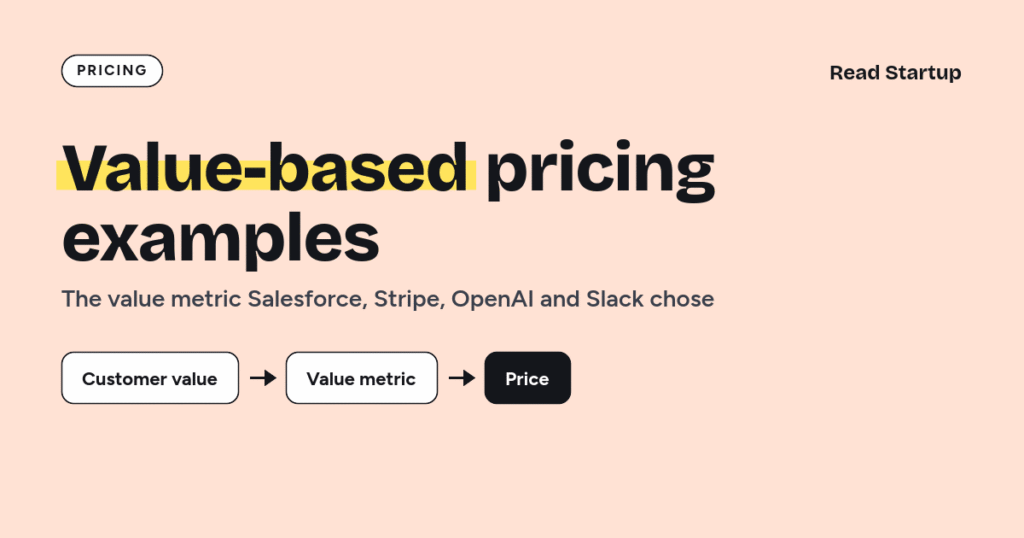
Value-based pricing sets the price from what the customer gains, not from what the product costs to make. Salesforce prices per seat, Stripe takes a share of each payment, and AI companies charge by usage; each picked a different value metric.
This page is part of Read Startup’s pricing case studies and one of the types of pricing strategies. It shows the value metric four companies chose and gives a three-question test for picking yours.
What is value-based pricing?
Value-based pricing sets prices according to the value a customer receives, measured with a value metric such as users, transactions or usage. It captures more when the customer succeeds and lets price grow with the customer.
A value metric is the unit you charge by. The whole strategy turns on choosing it well. Charge by something that rises as the customer gets more out of the product, and your revenue grows when theirs does. Charge by something unrelated to their benefit, and every bill feels like a tax. Value-based pricing does not mean expensive: a well-chosen metric often makes the product cheap for small customers.
How does value-based pricing work?
The company picks a value metric that rises with the customer’s benefit, sets price as a share of that benefit, and segments customers whose value differs. Revenue then expands as customers grow.
- Choosing the value metric. Start from the outcome the customer buys for, then find a countable unit that moves with it: seats for a sales team, payments for a shop, calls for an API.
- Per-seat vs usage-based vs percentage pricing. Per-seat pricing charges for each user. Usage-based pricing charges for consumption, such as API calls. Percentage pricing takes a share of the money that flows through the product.
- Willingness-to-pay research. Customer interviews reveal what the outcome is worth to different segments, which sets how big a share of that value you can charge.
- Expansion revenue as customers grow. When a customer adds staff, processes more payments or uses more, their bill rises without a new sale. This expansion revenue is the main prize of value-based pricing.
Which companies use value-based pricing, and which value metric did each choose?
Salesforce charges per seat because each salesperson’s productivity is the value; Stripe takes a share of every payment; OpenAI charges by usage; Slack bills only for active users. Each metric grows as the customer gets more value.
| Company | Value metric | Why it fits | Source |
|---|---|---|---|
| Salesforce | Per user (seat), per month | Each salesperson using it is the value | Salesforce pricing page |
| Stripe | Percentage of each payment, plus a fixed fee | Stripe earns only when the customer earns | Stripe pricing page |
| OpenAI | Usage (tokens) for the API; tiered subscriptions for ChatGPT | Heavier use means more value | OpenAI pricing page |
| Slack | Active users only (Fair Billing Policy) | Customers pay for people who actually use it | Slack Fair Billing Policy |
Salesforce: per-seat pricing tied to sales productivity
Salesforce charges for each user each month. For a sales team, every salesperson who logs deals in the system is getting value, so the seat is a reasonable proxy. As a customer hires more salespeople, its bill rises automatically. The weakness is the classic per-seat one: companies pay for seats that sit unused.
Stripe: a percentage of every payment processed
Stripe charges a percentage of each card payment plus a small fixed fee. A shop that sells nothing pays almost nothing; a shop that grows pays more. The metric is close to perfect, because the bill moves exactly with the customer’s revenue. Read how Stripe won developers first.
OpenAI: usage-based API pricing and tiered subscriptions
OpenAI prices its API by usage, measured in tokens, the chunks of text a model reads and writes. Developers pay in proportion to how much they use. For consumers, ChatGPT uses tiered monthly plans. Usage pricing fits the cost structure too, since heavier use costs more compute. Usage-based pricing sits close to dynamic pricing when rates vary by demand. Read the OpenAI breakdown.
Slack: billing only for active users
Slack’s Fair Billing Policy charges paid workspaces only for members who are active, and credits the account when someone stops using it. It fixes the main complaint about per-seat pricing by making the seat match real use. Read the Slack breakdown.
When does value-based pricing fail?
Value-based pricing fails when the value metric does not match what customers feel they get, such as charging per seat when few seats are used, or when bills become hard to predict.
- The metric does not match felt value. A customer paying for 50 seats when 10 people log in feels overcharged, however good the product is.
- Unpredictable bills. Usage pricing that produces a surprise bill makes finance teams cap or cancel. Customers need to forecast what they will pay.
- A metric that is hard to measure. If you cannot count the metric cheaply and reliably, disputes follow every invoice.
How do you pick a value metric?
Use three questions: does the metric rise when the customer is more successful, can the customer predict their bill from it, and can you measure it cheaply and reliably? A good metric passes all three.
- Does it rise when the customer succeeds? Stripe’s payment share passes easily. A flat fee fails, because the best customers pay the same as the worst.
- Can the customer predict it? Seats are easy to forecast; raw usage is harder, which is why many usage-based products add caps, alerts or prepaid tiers.
- Can you measure it cheaply? Payments, seats and API calls are already counted by the product. Outcomes such as “revenue influenced” are not.
If two metrics pass, pick the one customers already use when they describe the value to their boss.
How can you apply value-based pricing to your own business?
Interview customers about the outcome they buy for, choose a metric that rises with it, set price as a share of measured value, and review the metric each year as the product changes.
- Interview customers on the outcome they buy for. Ask what changed after they started using you, and how they measure it.
- Choose a metric that rises with that outcome. Run it through the three-question test above.
- Set price as a share of measured value. Charge a fraction of what the customer gains, so the deal is obviously good for them.
- Review the metric yearly. As the product changes, the unit that tracks value can change too.
Frequently asked questions about value-based pricing
What is value-based pricing?
Value-based pricing sets the price according to the value the customer receives, rather than the cost of making the product. It uses a value metric, such as seats, payments or usage, so the bill grows as the customer gets more benefit.
What is an example of value-based pricing?
Stripe is a clear example: it charges a percentage of each payment it processes, so a business pays more only as it sells more. Salesforce’s per-seat pricing and OpenAI’s usage-based API pricing are other examples.
How is value-based pricing different from cost-plus pricing?
Cost-plus pricing adds a markup to what the product costs to make; value-based pricing starts from what the customer gains. Cost-plus ignores customer value, so it often leaves money behind when value is high.
What is a value metric?
A value metric is the unit a company charges by, such as seats, payments or usage, chosen so the bill rises as the customer gets more value from the product. Choosing it is the core decision in value-based pricing.
Is usage-based pricing value-based?
Usually, yes, when usage tracks the value the customer gets, as with API calls or payments. It is not value-based if usage rises without benefit to the customer. Unlike premium pricing, it does not rely on brand to justify the price.
Run your current pricing through the three-question test, and change the metric before you change the price. Compare more pricing decisions in our pricing case studies, or get one company decision broken down twice a week.
By the Readstartup Team. Pricing structures are described from each company’s public pricing pages; corrections are logged on our Corrections Policy page.
More guides
Transparent Pricing Examples: Companies That Won by Exposing Hidden Fees
Transparent pricing examples from Wise, Southwest Airlines and Costco: how showing the real price beat rivals who relied on hidden fees, and what it…
Premium Pricing Examples
Premium pricing examples from Hermès, Apple, Liquid Death and Patagonia: how brands hold high prices permanently, and what keeps a premium from collapsing into…
Decoy Pricing Examples
Decoy pricing examples from The Economist experiment, cup sizes, popcorn and SaaS pricing pages: how a third option steers choice, and how to tell…