Price skimming examples from the original iPhone, Tesla's Roadster and game console launches. How starting high and cutting later captures early buyers, and what it costs.
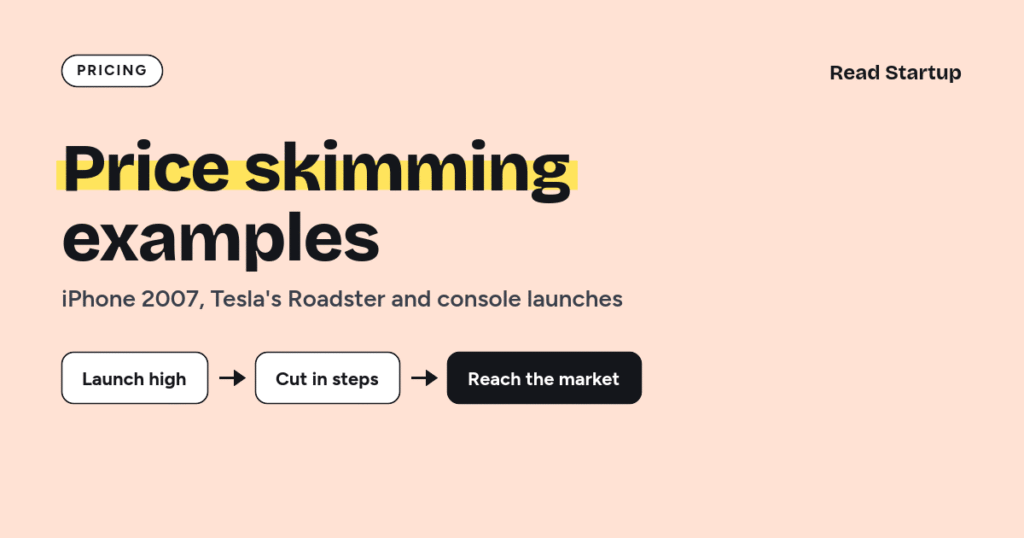
Price skimming launches a product at a high price for eager early buyers, then lowers it to reach the wider market. Apple cut the original 8GB iPhone from $599 to $399 ten weeks after launch; Tesla sold an expensive Roadster first to fund cheaper cars.
This page is part of Read Startup’s pricing case studies and one of the types of pricing strategies. It covers when skimming works, three real cases, and what it costs in trust.
What is price skimming?
Price skimming is setting a high initial price for a new product to capture buyers willing to pay most, then lowering the price in steps to reach more price-sensitive customers.
The name comes from skimming cream off milk: the company takes the top layer of demand first. Each step down the price ladder opens a new group of buyers who wanted the product but would not pay the launch price. Skimming is temporary by design. A product that stays expensive on purpose is using premium pricing, not skimming.
How does price skimming work?
Skimming works when early adopters value novelty, competitors cannot copy quickly, and production costs fall with volume, so each price cut still leaves margin.
- Early adopter willingness to pay. Some buyers want to be first and will pay for it. The launch price is set for them, not for the average customer.
- Barriers that delay competitors. Patents, supply deals, brand or a hard-to-copy design buy the time skimming needs. Without them, a fast follower undercuts the launch price.
- Falling unit cost with volume. As production scales, each unit gets cheaper to make, so the company can cut the price and keep its margin.
- Managing early-buyer backlash after cuts. Every price cut tells early adopters they overpaid. The faster and deeper the cut, the louder the complaint.
Skimming is the opposite of penetration pricing, which launches low to win share and raises prices later.
Which companies used price skimming?
Apple cut the 8GB iPhone from $599 to $399 on 5 September 2007, about ten weeks after launch. Tesla sold the Roadster first to fund cheaper models, and console makers routinely cut prices after launch.
| Company | Launch price | Later price | Time between | Source |
|---|---|---|---|---|
| Apple iPhone (8GB) | $599 (29 June 2007) | $399 (5 September 2007) | About ten weeks | CNN Money, 6 Sept 2007 |
| Tesla | Roadster sports car first | Model S, then Model 3 | Years, per the 2006 plan | Tesla blog, August 2006 |
| Game consoles | High launch price | Price cuts and cheaper “slim” models | Usually within a few years | Company announcements |
Apple iPhone (2007): a $599 launch price cut to $399
The iPhone went on sale in the US on 29 June 2007 at $499 for 4GB and $599 for 8GB. On 5 September 2007 Apple cut the 8GB model to $399 and dropped the 4GB version. The first buyers had paid a $200 premium for having it about ten weeks earlier. The cut came before the holiday season, when a lower price could reach far more buyers.
Tesla: the Roadster first, then cheaper models
Tesla’s first car was a low-volume, high-price electric sports car. Its buyers were wealthy early adopters who wanted a fast electric car and could afford to pay for the cost of building one in small numbers. Each later model was cheaper and aimed at a bigger market. The sequence was published in advance, which is rare.
Game consoles: high launch prices, then price cuts and slim models
Console makers usually launch at their highest price, sell to the most committed players, then cut the price and release cheaper slim versions as components get cheaper. It is skimming on a predictable schedule, and many buyers wait for the first cut.
When does price skimming fail?
Skimming fails when a fast follower launches cheaper or when early buyers feel cheated by a quick cut. After its 2007 iPhone cut, Apple gave early buyers a $100 Apple Store credit to contain the backlash.
The iPhone cut drew angry emails from customers who had bought weeks earlier. On 6 September 2007, the day after the cut, Steve Jobs published an open letter that defended the cut but conceded Apple had to do a better job looking after early customers, and he offered a $100 Apple Store credit to buyers who did not qualify for a refund (CNN Money, September 2007). Apple kept the lower price and paid to repair trust.
The second failure is competition. Skimming only lasts as long as the product is hard to copy. If a rival can match the product at a lower price before you cut, your high launch price hands them the market.
How did Tesla use skimming to fund growth?
Tesla’s 2006 “Master Plan” blog post openly described selling an expensive sports car first, using that money to build a cheaper car, then an affordable one. Skimming here was a capital strategy, not only a pricing tactic.
In August 2006 Tesla published “The Secret Tesla Motors Master Plan”. It set out the sequence: build a sports car, use that money to build an affordable car, use that money to build an even more affordable car. The Roadster, then the Model S, then the Model 3 followed that path.
The point is not just that early buyers paid more. A new car maker cannot build a mass-market car without factories, supply chains and cash. Selling a few expensive cars to people who wanted them most raised money and proved the technology before the company tried volume. That makes skimming part of a go-to-market strategy, not just a price list. Read Tesla’s master plan breakdown.
When should a startup use price skimming?
Launch high only if you have a real lead, plan the price steps and their timing, confirm cost falls with volume, and decide in advance how you will treat early buyers when you cut.
- Have a real lead. Skimming needs months, ideally years, before a rival can match you.
- Plan the price steps and timing. Write down each price and the date or volume that triggers the next cut.
- Confirm cost falls with volume. If your unit cost stays flat, every cut comes straight out of margin.
- Decide how you will treat early buyers. A credit, an upgrade or a price guarantee set in advance costs less than an apology later.
Frequently asked questions about price skimming
What is price skimming?
Price skimming is launching a new product at a high price to capture buyers who will pay most, then lowering the price in steps to reach more price-sensitive buyers. It suits new products with few substitutes and costs that fall as volume grows.
Why did Apple cut the iPhone price in 2007?
Apple cut the 8GB iPhone from $599 to $399 on 5 September 2007 to reach more buyers before the holiday season. After complaints from people who had just bought one, Steve Jobs offered early buyers a $100 Apple Store credit.
What is the difference between price skimming and premium pricing?
Skimming starts high and is meant to come down; premium pricing keeps the price high permanently because the price signals quality. A skimming company plans its cuts; a premium brand avoids them.
What are the risks of price skimming?
The main risks are a fast follower launching a cheaper alternative, early buyers feeling cheated by a quick price cut, and sales stalling if the launch price is so high that few buy. Each needs a plan before launch.
Which industries use price skimming most?
Consumer electronics, game consoles, cars and other technology products use skimming most, because they launch with novelty, have early adopters who pay for being first, and see unit costs fall as production scales.
If you launch high, write the price ladder and the early-buyer policy before the first sale. Compare it with the other launches in our pricing case studies, or get one company decision broken down twice a week.
By the Readstartup Team. Figures are attributed to their source and dated; corrections are logged on our Corrections Policy page.
More guides
Transparent Pricing Examples: Companies That Won by Exposing Hidden Fees
Transparent pricing examples from Wise, Southwest Airlines and Costco: how showing the real price beat rivals who relied on hidden fees, and what it…
Premium Pricing Examples
Premium pricing examples from Hermès, Apple, Liquid Death and Patagonia: how brands hold high prices permanently, and what keeps a premium from collapsing into…
Decoy Pricing Examples
Decoy pricing examples from The Economist experiment, cup sizes, popcorn and SaaS pricing pages: how a third option steers choice, and how to tell…