Penetration pricing examples from Reliance Jio, Spotify, Zoom and Canva, and why MoviePass failed: how launching low or free wins share, and how to plan the exit.
Penetration pricing launches at a very low or free price to win market share fast, then earns money once customers are in. Reliance Jio used it to sign up 100 million people in 170 days; MoviePass shows how it ends when the price never rises.
This page is part of Read Startup’s pricing case studies (start with the types of pricing strategies), where every pricing mechanism is filed with the real companies that ran it, winners and failures side by side. The question this page answers is not “should you launch cheap?” but “how does a cheap launch end?”, because that ending decides whether the low price was a strategy or just a subsidy.
What is penetration pricing?
Penetration pricing sets a low introductory price, sometimes free, to win market share quickly, with a plan to raise prices or sell more later. It works only when scale lowers cost or creates lock-in before the subsidy runs out.
The goal of penetration pricing is fast market share. A low launch price buys that share by removing the main reason a customer would not try something new: the cost of trying it. The company gives up margin today in exchange for a large customer base it can earn from tomorrow.
Two conditions separate penetration pricing from simply being cheap:
- There is a planned exit. The price is low for a period or for a tier, and the company knows what it will charge for later.
- Something gets stronger as the customer base grows. Unit costs fall, the product becomes more useful as more people join, or customers build up data and habits that make leaving costly.
If neither condition holds, a low price is just a discount that customers will expect forever. That is the misconception this page exists to correct: you cannot always raise prices later. You can raise them only if you built a reason for customers to stay before you did.
How does penetration pricing work?
The company accepts low or negative margin to grow usage, then earns it back through scale economies, network effects, switching costs or upsells. The exit from low prices has to be planned before launch, not discovered after the money runs low.
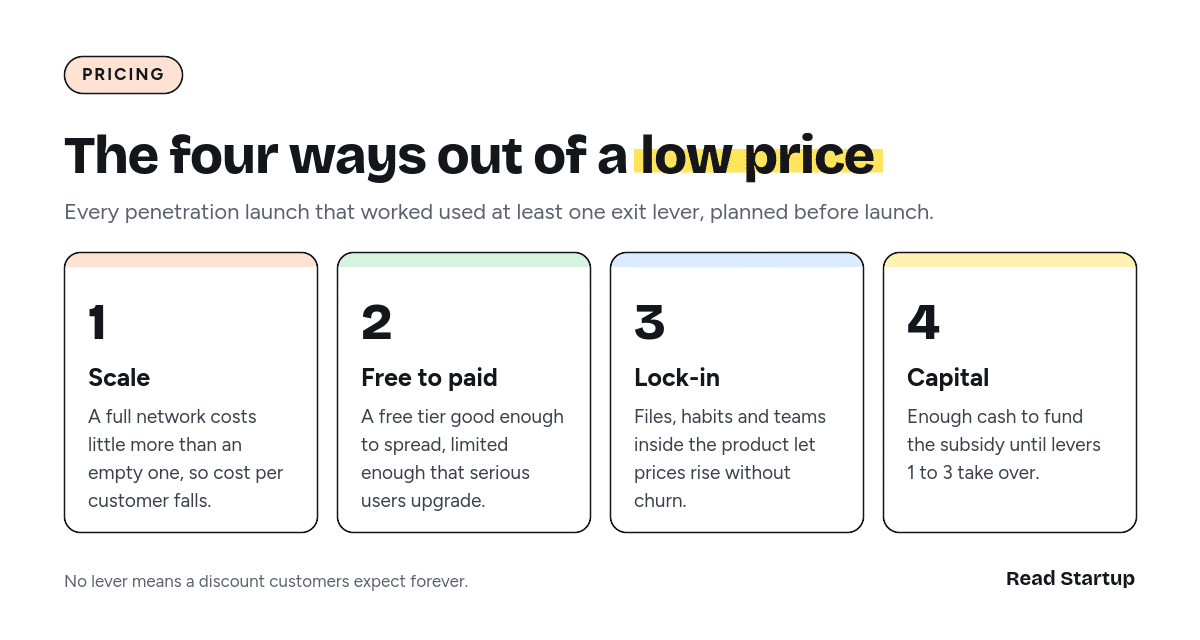
Those four exit levers are the whole mechanism. Every successful example on this page used at least one of them:
- Scale lowering unit cost. A network, warehouse or server fleet costs roughly the same whether it is half empty or full. Filling it with low-paying customers drives the cost per customer down until the original price becomes profitable.
- Free tier to paid conversion. In a freemium model, the free tier is the low price, and the paid tier is the exit. The free version has to be good enough to spread and limited enough that serious users upgrade.
- Lock-in that survives a price rise. Switching costs let prices rise without churn. Once a customer’s files, contacts, playlists or team workflows live inside a product, a modest price increase costs them less than moving.
- Capital to fund the subsidy period. The low price has to last until one of the first three levers takes over. Running out of money one month early means the strategy never reaches its exit.
The founder objection we see most often at this point is “we will figure out monetisation later.” The cases below show why that answer is the single best predictor of failure. Freemium products that won had a paid tier designed on day one; the ones that lost added pricing as an afterthought.
Which companies used penetration pricing, and how did it end?
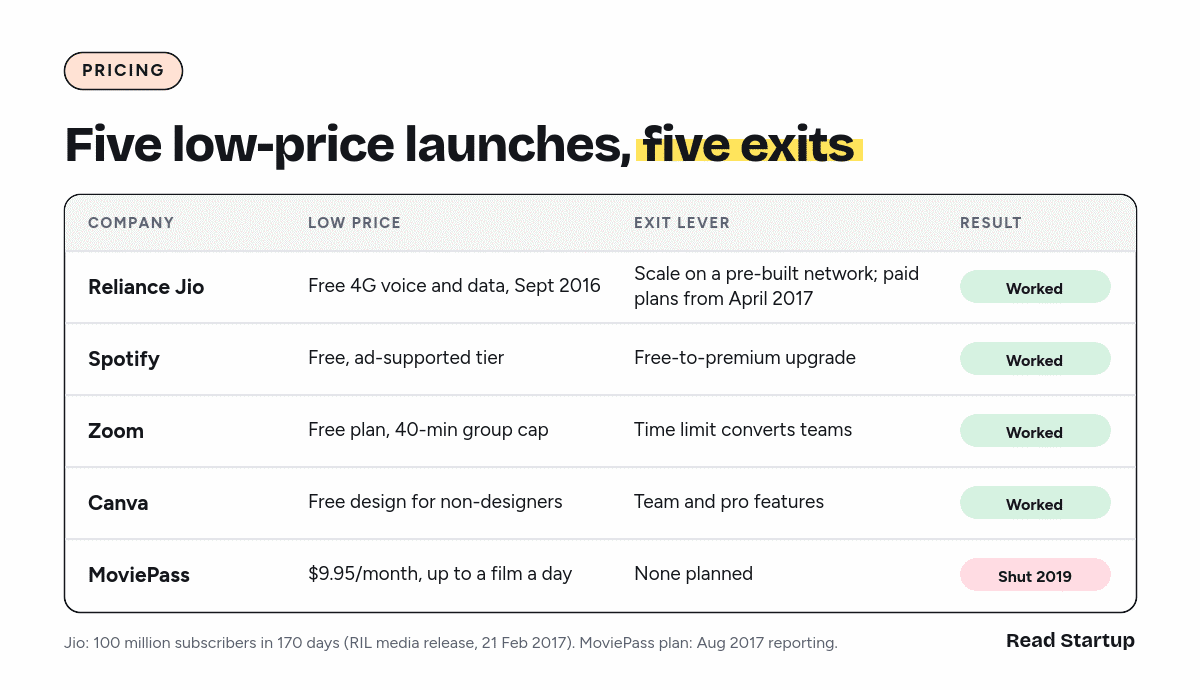
Two companies used low prices to reshape whole markets, two used free tiers that converted teams to paid plans, and one kept a low price with no way to raise it. The exit lever, not the launch price, explains the outcome.
| Company | Low price | Exit lever | Outcome | Source |
|---|---|---|---|---|
| Reliance Jio | Free 4G voice and data from September 2016 | Scale on a pre-built network; paid plans from April 2017 | 100 million subscribers in 170 days | RIL media release, 21 February 2017 |
| Spotify | Free, ad-supported tier priced against piracy | Free-to-premium conversion | Free listening became the entry point to paid subscriptions | Company product structure |
| Zoom | Free plan with a 40-minute cap on group meetings | Time limit converts regular team users | Free meetings spread inside companies before procurement got involved | Zoom free plan terms |
| Canva | Free design tools for non-designers | Team and pro features | Free users became the base for paid team plans | Company product structure |
| MoviePass | $9.95 per month for near-unlimited cinema tickets | None planned | Losses on every active subscriber; the service shut in September 2019 | Reporting, August 2017 and 2019 |
Reliance Jio: free data as a market reset
Jio launched in September 2016 with free 4G voice and data and, according to its own media release, crossed 100 million subscribers in 170 days. The exit was already built: a nationwide network sized for that load, and paid plans from April 2017. Read how Jio rewired a billion-person market for the full decision.
Spotify: a free tier priced against piracy
The music service’s real competitor was not another paid service but free, illegal downloads. An ad-supported tier matched piracy’s price and beat it on convenience, then sold the upgrade. The full story is in how Spotify beat piracy.
Zoom: a free plan that spread inside companies
The free plan was generous enough for anyone to host a meeting, and every guest experienced the product without signing up. The 40-minute limit on group meetings was the exit: teams that met daily paid. See the full Zoom breakdown.
Canva: free design for people who are not designers
The company gave non-designers a free tool that was easier than professional software, then charged teams for brand kits and collaboration. Read how Canva beat Adobe.
MoviePass: a low price with no exit
The $9.95 plan, introduced in August 2017, paid cinemas close to full ticket price for every film a subscriber watched. More usage meant more losses. There was no scale benefit, no lock-in and no paid tier to move people to. The full MoviePass breakdown runs the numbers.
When does penetration pricing fail?
Penetration pricing fails when customers came only for the price and leave when it rises, when capital runs out before scale arrives, or when nothing locks customers in once the subsidy ends. The main cause is no planned exit from the low price.
That is the direct answer to “we will figure out monetisation later.” The movie-ticket subscription above is the clearest proof: it grew fast precisely because the price made no economic sense, and every new subscriber deepened the hole. No exit plan turns penetration pricing into a growth trap, where growth makes the business weaker instead of stronger.
The three failure modes look like this:
- Customers came only for the price. If the product has no advantage beyond being cheap, the first price rise sends customers to the next cheap option. Ask whether a customer would stay at full price after three months of use. If you cannot answer yes for a clear segment, the low price is buying rentals, not customers.
- Capital runs out before scale. The subsidy period is a cash countdown. The Indian telecom newcomer could sustain it because its parent had funded the network in advance; most startups are funding the subsidy from the same round that pays salaries.
- No lock-in to survive a price rise. Lock-in has to exist before the price changes. Saved playlists, daily meeting habits and stored brand kits all existed before users were asked to pay. A price rise announced before that point simply tests how many customers were only there for free.
A useful self-check: write down the exact date or usage threshold at which a customer starts paying, and the lever that makes them accept it. If either line is blank, the plan is not penetration pricing yet.
Why did Jio’s free data work in India?
Jio combined free data with a nationwide 4G network built in advance and Reliance’s balance sheet, so it could sustain the subsidy while rivals could not. Other markets would need the same mix of capacity, capital and unmet demand for free launches to work.
Most write-ups mention the free data and stop. The conditions behind it are what make the case useful, because they are a checklist you can hold any free launch against:
- A nationwide 4G network built before launch. Pre-built capacity made the subsidy sustainable. Adding millions of users to a network already paid for raised usage far faster than cost.
- The parent company’s balance sheet to fund the subsidy. Reliance Industries could absorb months of free service. A startup with 18 months of runway cannot.
- Rivals could not match without large losses. Incumbents on older networks would have lost money on every free user. Matching the price hurt them more than it hurt the newcomer.
- Data-hungry users switching on cheap smartphones. Demand was already there and under-served. The free price removed the last barrier, rather than creating demand from nothing.
The exit came on schedule: the Prime membership was announced in February 2017 and paid tariffs began in April 2017. The 100 million figure comes from the company’s own release, so treat it as a company-reported number as of 21 February 2017.
This is also where penetration pricing meets disruption. A newcomer with lower costs using price to enter a market incumbents cannot defend is a form of low-end disruption; our disruption case studies cover that path, which is beyond the scope here.
How can you apply penetration pricing to your own business?
Decide in advance what you will charge for and when, confirm your unit cost falls with scale, test retention after a price rise on one cohort, and secure funding for the whole subsidy period before you announce the low price.
- Decide what you will charge for and when. Write the exit before the launch: a date, a usage limit or a feature tier. Zoom’s time cap and Canva’s team features are both exits that users can see from the start.
- Confirm your unit cost falls with scale. Model the cost of serving customer 1,000 versus customer 100,000. If it barely moves, scale will not rescue the low price.
- Test retention after a price rise on one cohort. Raise the price for one cohort before full rollout. A cohort price test reveals price sensitivity without risking the whole base, and tells you whether your lock-in is real.
- Fund the full subsidy period. Count the months until the exit lever pays and raise or reserve that cash first. A plan that needs a future round to survive the subsidy is a bet, not a strategy.
From the cases in this library, the pattern is consistent: the winners could name their exit lever in one sentence before launch. The founders who could not usually ended up in the failure column.
Frequently asked questions about penetration pricing
What is penetration pricing?
Penetration pricing is a launch strategy that sets a very low or free price to win market share quickly, then raises prices or sells upgrades once customers are in. It only works when a planned exit lever, such as scale, network effects, switching costs or upsells, makes customers stay after the low price ends.
What is the difference between penetration pricing and price skimming?
They are opposites. Penetration pricing starts low to win share fast and earns later; price skimming starts high to earn the most from early buyers who want the product most, then lowers the price to reach the wider market. Penetration suits markets where share compounds; skimming suits products with strong early demand.
Is freemium a form of penetration pricing?
Yes, when the free tier is designed as an entry point to a paid plan. Freemium sets the lowest possible price for a limited version, and the exit is conversion to the paid tier. It fails as penetration pricing when the free tier is so complete that users never have a reason to pay.
Is penetration pricing legal?
Usually, yes. Pricing low to win customers is ordinary competition. It can become illegal when it turns into predatory pricing: pricing below cost to eliminate rivals, which competition law can prohibit. The rules and tests differ by country, so the same price could be lawful in one market and challenged in another. This is not legal advice; below-cost pricing can breach competition law in some markets.
How did Jio use penetration pricing?
Reliance Jio launched in September 2016 with free 4G voice and data, reached 100 million subscribers in 170 days according to its 21 February 2017 media release, and moved users to paid plans from April 2017. A pre-built national network and Reliance’s capital made the free period sustainable.
What should you do differently after reading this?
Treat the exit as the strategy and the low price as the tactic. Before you launch, write one sentence naming the lever that will make customers pay later: lower unit cost at scale, a product that improves as more people join, data and habits that make leaving costly, or a paid tier worth upgrading to. Then test that lever on one cohort before you depend on it. The decision criterion is simple: if you cannot name the exit lever and fund the months until it works, do not launch low. Read Startup files every pricing decision by mechanism so you can compare your plan with companies that ran it before you. To get one company decision broken down twice a week, subscribe free.
By the Readstartup Team. Figures are attributed to the company or report they come from and dated; corrections are logged on our Corrections Policy page.
More guides
Transparent Pricing Examples: Companies That Won by Exposing Hidden Fees
Transparent pricing examples from Wise, Southwest Airlines and Costco: how showing the real price beat rivals who relied on hidden fees, and what it…
Premium Pricing Examples
Premium pricing examples from Hermès, Apple, Liquid Death and Patagonia: how brands hold high prices permanently, and what keeps a premium from collapsing into…
Decoy Pricing Examples
Decoy pricing examples from The Economist experiment, cup sizes, popcorn and SaaS pricing pages: how a third option steers choice, and how to tell…