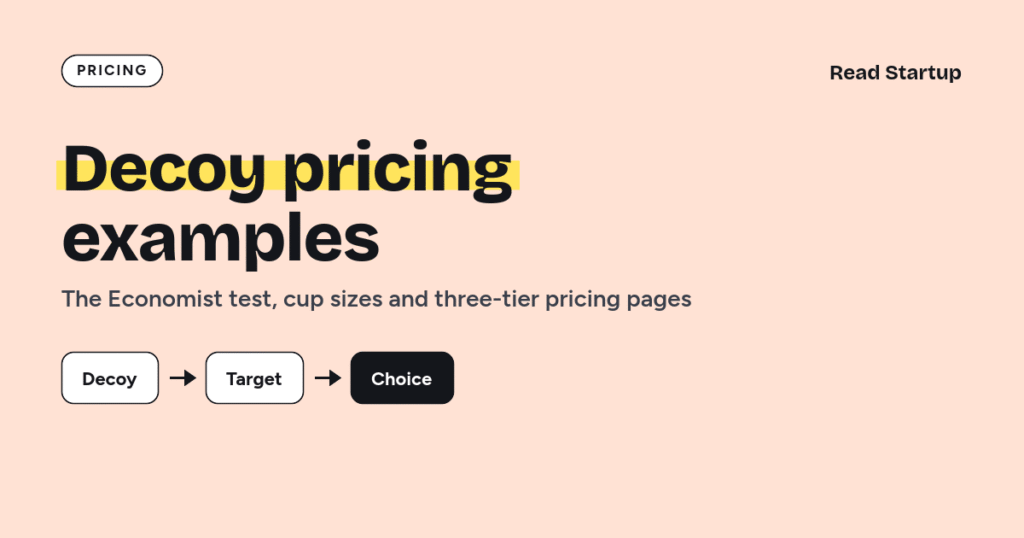
Loss leader pricing examples from Costco's $1.50 hot dog, Amazon's Kindle and game consoles, and why Nintendo chose to profit on the Wii instead.
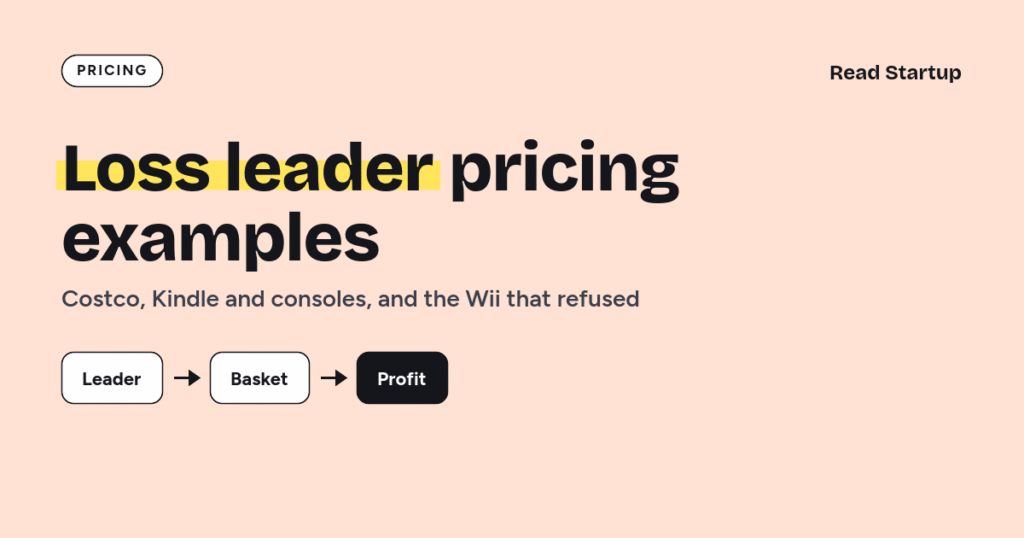
A loss leader is a product sold at or below cost to bring customers in for other, profitable purchases. Costco’s $1.50 hot dog, unchanged since the 1980s, Amazon’s Kindle and many game consoles are textbook cases.
This page sits in Read Startup’s pricing case studies, next to the types of pricing strategies. It covers how a loss leader pays for itself, four real cases, and the company that refused to use one.
What is loss leader pricing?
Loss leader pricing sells one product at or below cost to attract customers who then buy higher-margin products. The loss is a marketing cost, and it only pays if enough customers buy the profitable items.
The leader is not meant to make money on its own. It is closer to an advertising budget spent at the shelf: instead of paying for a billboard, the company pays for the gap between cost and price on one well-known item, and recovers it on everything else in the basket. That is why the right question is never “does the leader lose money?” It always does, by design. The question is whether the basket around it earns more than the leader loses.
How does loss leader pricing work?
The leader is chosen for visibility and frequency; profit comes from attached purchases, memberships or content. Measure attach rate and profit per basket, not the leader’s own margin.
Choosing a visible, frequently bought leader
A good leader is something customers know the usual price of and buy often: milk, eggs, a hot dog, a console. If nobody notices the price, the loss buys nothing.
Attach rate on profitable items
Attach rate is the share of leader buyers who also buy something profitable on the same visit or account. It decides whether the loss pays. A low attach rate means you are subsidising bargain hunters.
Limits that stop cherry-picking
Cherry-picking is buying only the leader and leaving. Retailers defend against it with quantity limits, membership requirements, or by placing the leader at the back of the store so customers walk past everything else.
Price anchoring and brand perception
A famous low price anchors the whole store as good value. The risk runs the other way too: a brand known only for cheap leaders can start to look cheap.
The test fits on one line: profit per basket = basket revenue − basket variable cost, including the leader’s loss. If that number beats the basket without the leader, the leader works.
Which companies used loss leaders?
Costco keeps its hot dog combo at $1.50 to anchor value and support memberships; Amazon sold Kindles near cost to sell e-books; consoles have often launched below cost to sell games. Nintendo’s Wii did the opposite.
| Company | Leader | What it sells next | Source |
|---|---|---|---|
| Costco | $1.50 hot dog and soda, since 1985 | Memberships and the rest of the trip | OPB / NPR, 4 June 2024 |
| Amazon | Kindle e-readers and tablets sold at cost | E-books, apps and content | Jeff Bezos to the BBC, Oct 2012 |
| Sony, Microsoft | Console hardware priced below build cost at launch | Games, licences and subscriptions | Industry teardowns and reporting |
| Nintendo | Wii hardware sold at a profit (the counter-example) | Hardware and games | Reggie Fils-Aimé, Nov 2006 |
Costco: the $1.50 hot dog and soda
Costco has charged $1.50 for its hot dog and soda combo since 1985, and it told reporters in 2024 that the price was not going up (OPB / NPR, 4 June 2024). The hot dog is not the business. It is a promise of value at the exit of every warehouse, and it supports the annual fee that does earn money; see our membership pricing examples. Read the full Costco breakdown.
Amazon Kindle: e-readers near cost to sell e-books
In October 2012 Jeff Bezos told the BBC that Amazon sells its Kindle hardware at cost and makes money when people use the devices, not when they buy them. The device is the leader; e-books and content are the basket. Unlike a supermarket leader, the Kindle keeps selling for years after the one purchase.
Game consoles: hardware sold at a loss, games at a profit
Sony and Microsoft have often launched consoles priced below what they cost to build, reported in teardowns at launch, and recovered the loss through game licensing, accessories and online subscriptions. The leader only pays if owners buy enough games over the console’s life, so attach rate, games sold per console, is the number the industry watches.
Nintendo Wii: weaker hardware sold at a profit
Nintendo went the other way. Its Wii launched in November 2006 at $249.99 in the US, well below rivals, yet Nintendo of America’s Reggie Fils-Aimé said the console was profitable from launch. It did not need a loss leader because it did not try to win on hardware.
When does loss leader pricing fail?
Loss leaders fail when customers buy only the leader, when the leader’s loss grows faster than attached profit, or when the brand starts to look cheap. Retailers cap quantities for this reason.
- Cherry-picking. Bargain hunters buy the leader and leave. Without limits or a membership gate, the loss scales with the wrong customers.
- The leader’s loss outruns attached profit. When the cost of the leader rises, through inflation or a more expensive component, and attached margin does not, the gap widens each year. Costco absorbs this on the hot dog because fees and the wider basket cover it.
- The brand starts to look cheap. A leader should say “good value”, not “low quality”. A premium brand that runs loss leaders can damage the price customers will pay elsewhere.
- Weak attach rate. A console that sells but does not sell games is a pure loss.
Why did Nintendo refuse to sell the Wii at a loss?
Instead of matching rivals’ expensive hardware and subsidising it, Nintendo built the Wii from cheaper components and priced it to make money on each unit, aiming at families and non-gamers rather than spec-chasers.
Sony and Microsoft were competing on graphics power, which meant costly chips and a launch price below build cost. Nintendo chose not to fight there. The Wii used less powerful, cheaper parts and put its difference into the motion controller and simple games that people who did not play video games would try. Fils-Aimé said in November 2006 that each console sold was profitable from day one.
The lesson for pricing is a positioning one: a loss leader is a cost you take on to compete on someone else’s terms. If you change the terms, you may not need it. Read the full Nintendo Wii breakdown.
How can you apply loss leader pricing to your own business?
Pick a leader customers notice and buy often, measure profit per basket rather than per item, limit quantities, and stop if attached margin does not cover the loss within a set period.
- Pick a leader customers notice and buy often. It should be a product whose normal price people know.
- Measure profit per basket, not per item. Track attach rate and the margin on what comes with the leader.
- Limit quantities. Cap units per customer or gate the leader behind an account or membership.
- Set a deadline. Decide in advance how many weeks attached margin has to cover the loss, and end the test if it does not.
Frequently asked questions about loss leader pricing
What is a loss leader?
A loss leader is a product sold at or below cost to attract customers who will buy other, profitable products. Supermarket staples, Costco’s $1.50 hot dog combo and many game consoles at launch are common examples. The loss is treated as a marketing cost.
Why is the Costco hot dog still $1.50?
Costco has held the hot dog and soda combo at $1.50 since 1985 as a signal of value that brings members back, and said in 2024 it had no plans to raise it. The low price supports the membership fees and the rest of each shopping trip.
Is loss leader pricing legal?
In most places, yes, but some US states and several EU countries restrict selling below cost, especially for groceries or fuel, and predatory pricing aimed at driving rivals out can break competition law. Check local rules; this is not legal advice.
What is the difference between a loss leader and the razor and blade model?
A loss leader drives one visit and hopes for a profitable basket; the razor and blade model locks the customer into repeat purchases of refills that only fit the product. Razor and blade adds lock-in that loss leaders lack.
Do game consoles lose money?
Many consoles have launched priced below their build cost, with the maker earning on games and subscriptions instead. Not all do: Nintendo said its Wii was profitable on each unit from launch in 2006.
Before you price anything below cost, write down the basket you expect it to bring and the date by which that basket must cover the loss. For more decisions like this, browse the pricing case studies, or get one company decision broken down twice a week.
By the Readstartup Team. Figures are attributed to their source and dated; corrections are logged on our Corrections Policy page.
More guides
Transparent Pricing Examples: Companies That Won by Exposing Hidden Fees
Transparent pricing examples from Wise, Southwest Airlines and Costco: how showing the real price beat rivals who relied on hidden fees, and what it…
Premium Pricing Examples
Premium pricing examples from Hermès, Apple, Liquid Death and Patagonia: how brands hold high prices permanently, and what keeps a premium from collapsing into…
Decoy Pricing Examples
Decoy pricing examples from The Economist experiment, cup sizes, popcorn and SaaS pricing pages: how a third option steers choice, and how to tell…