Membership pricing model examples from Costco, Amazon Prime and Netflix, and why MoviePass lost money: how an access fee works, the heavy-user problem, and how to price a membership.
Membership pricing charges customers a fee for access before they buy anything. Costco’s fees equal about half its operating income (our estimate), Amazon Prime uses its fee to change where people shop, and MoviePass priced its fee below what members used.
This page sits in Read Startup’s pricing case studies (start with the types of pricing strategies), where each pricing mechanism is filed with the real companies that ran it. The question here is narrow and practical: why do some membership fees fund a whole business while others sink it? The answer comes down to one number most founders never calculate, the cost of serving your heaviest members.
What is membership pricing?
Membership pricing is a model where customers pay a recurring fee for the right to buy or use something, often at lower prices. The fee creates commitment, makes revenue predictable and changes behavior, because members try to get their money’s worth.
That behavioral shift is the real product. Once someone has paid an annual fee, every purchase elsewhere feels like wasting it. Members shift purchases to justify the fee, which is why a membership can be worth more than the fee itself: it moves a customer’s spending toward you before a competitor gets the chance.
A membership differs from a plain subscription in what it sells. A subscription delivers a product, such as a box of razors or a software license. A membership sells access: the right to shop, watch, ship or enter at better terms than non-members get.
Two things separate a strong membership model from a weak one:
- What the fee unlocks. Access to low prices, fast shipping or a content library gives members a reason to come back often.
- What each use costs you. If serving a member’s next visit costs almost nothing, heavy use is good. If each use costs real money, heavy use eats the fee.
How does membership pricing work?
A membership works when the fee plus margin on usage exceeds the cost of serving the average member, and above all the heaviest one. The levers are fee level, usage cost, renewal rate and how far the fee shifts purchases toward you.
Here are the four parts of the mechanism:
- The fee as profit versus the fee as a commitment device. Some companies treat the fee as their main earnings and sell goods near cost. Others use it mainly to lock in loyalty and earn on what members buy afterward. Both work; mixing them up does not.
- Usage cost and the heavy-user problem. Every membership has a small group that uses it far more than average. If each use carries a cost to you, that group can cost more than the fee they pay.
- Renewal rate as the core metric. The renewal rate is the share of members due for renewal who renew. It tells you whether members still see value, long before revenue does, and it is the single figure a membership business should report first.
- Sunk-cost behavior after joining. Members who have paid upfront visit more often to “use up” the fee. That behavior is exactly what makes heavy users either your best customers or your worst.
A practical observation from the cases in our library: founders usually model the average member and stop. The model only holds if it also survives the top fifth of users, because that is where the money is made or lost. How long members stay, and what they are worth over that time, belongs to unit economics case studies, which is beyond the scope of this page.
Which companies made membership pricing work, and which did not?
The warehouse club and Amazon’s program used the fee to lock in loyalty and shift spending, the streaming service priced its membership against content cost, and the cinema pass charged less per month than one heavy member’s cinema bill.
| Company | Fee | What the fee does | Outcome | Source |
|---|---|---|---|---|
| Costco | Annual fee; goods sold at low markups | Fee earns on top of near-cost goods | 92.3% renewal rate in the US and Canada; 89.8% worldwide | Costco FY2025 10-K |
| Amazon Prime | Launched in 2005 at $79 per year for two-day shipping | Shifts where members shop first | Built a habit of checking Amazon first | Amazon press release, February 2005 |
| Netflix | Monthly membership | Funds a content library every member can watch | Fee priced against content spend, not per view | Company model |
| MoviePass | $9.95 per month for up to one film a day | Paid cinemas for each film a member watched | Each extra film increased losses | Reporting, August 2017 |
Costco: the fee on top of near-cost goods
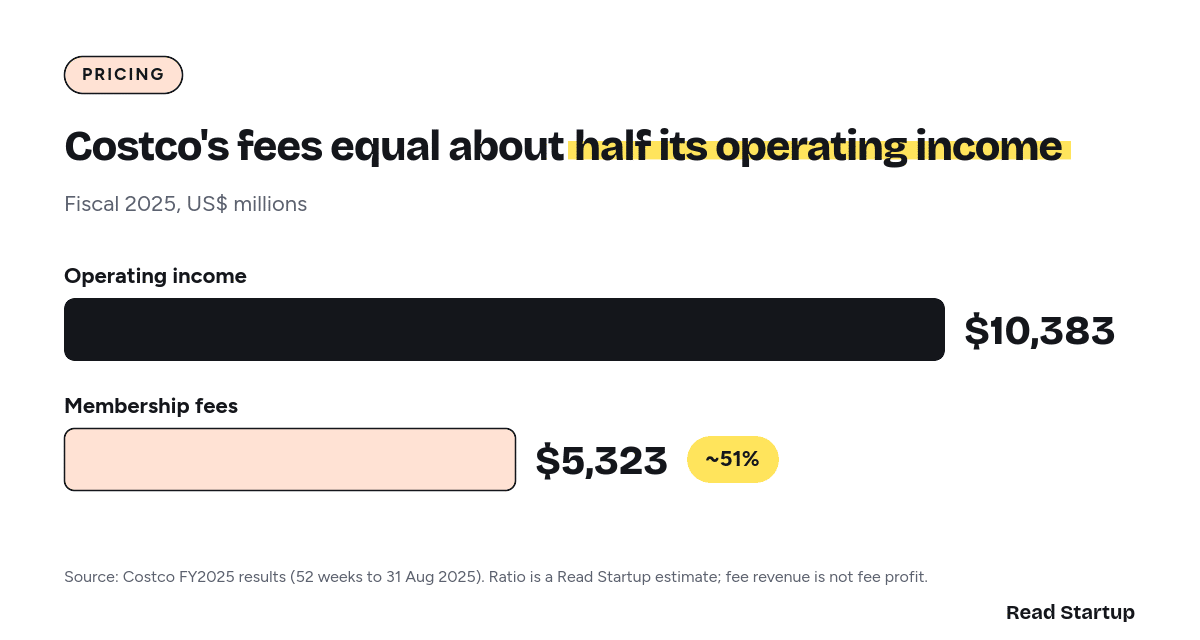
In fiscal 2025, the company reported $5,323 million in membership fees and $10,383 million in operating income, so membership fees were equal to about 51% of operating income (Read Startup estimate from the FY2025 results). Fee revenue is not the same as fee profit, so treat this as a ratio, not a claim about where profit comes from. The renewal rate was 92.3% in the US and Canada and 89.8% worldwide, per the FY2025 10-K. Low markups on goods give members a reason to return; Sam’s Club, Walmart’s warehouse club, runs the same fee-plus-low-margin structure. The low prices are not the same as loss leader pricing, because the goods are priced near cost across the store, not below cost on a few items. Read the full Costco breakdown.
Amazon Prime: a fee that changed where people shop
Amazon announced Prime in February 2005 at $79 per year for unlimited two-day shipping on eligible items. The point was not shipping revenue. A member who has prepaid for fast shipping checks Amazon first, which moves purchases away from other stores before the customer even compares prices.
Netflix: a membership priced against content spend
The streaming service charges a flat monthly membership for unlimited viewing. That works because a film costs the same to license whether one member or a million watch it, so heavy viewing does not raise costs per view. The decision that made it possible is in how it beat Blockbuster.
MoviePass: a fee below what members used
The cinema pass charged $9.95 a month from August 2017 for up to one film a day, and paid cinemas for each ticket a member used. At typical US ticket prices, two films a month already cost more than the fee. The full MoviePass breakdown runs the numbers.
The obvious objection here is that unlimited plans attract customers. They do. The next section shows why attracting the wrong ones is the problem.
Why did Costco’s membership work when MoviePass’s failed?
Both sold an upfront fee. The warehouse club’s fee is almost pure margin on top of near-cost goods, and heavy shoppers are its best customers. The cinema pass’s fee was smaller than a heavy user’s monthly cinema bill, so its best customers were its biggest losses.
| Factor | Costco | MoviePass |
|---|---|---|
| Fee vs cost of what members use | Fee sits on top of goods that already cover their own cost | Fee was below the cost of two cinema tickets |
| Effect of heavy users | More visits mean more sales at a small margin, plus a renewed fee | Each extra film increased losses |
| Renewal | 92.3% in the US and Canada (FY2025 10-K) | Loyal members were the most expensive ones, so loyalty deepened losses |
| What happens as members grow | Larger base, more buying power, lower prices | Larger base, larger monthly cash burn |
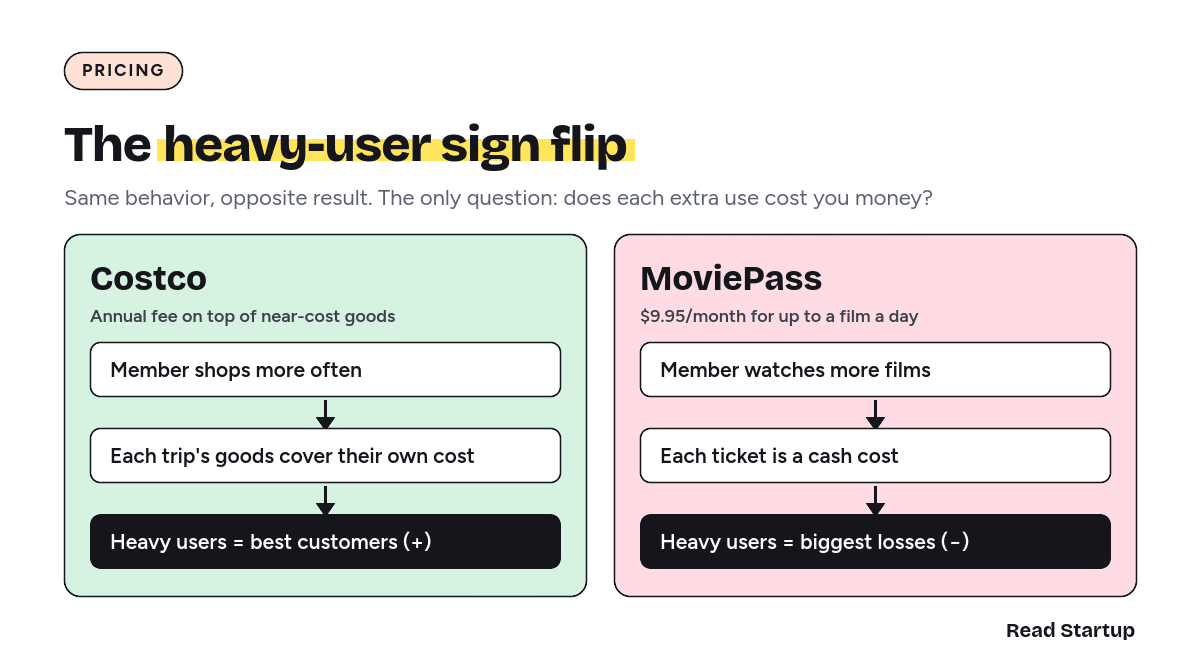
We call this the heavy-user sign flip. The same behavior, a member using the membership as much as possible, is positive at one company and negative at the other. The sign depends on a single question: does each extra use cost you money? At the warehouse club, a member’s extra shopping trip pays for itself through the goods’ margin. At the cinema pass, a member’s extra film was a direct cash cost.
That is the answer to “unlimited plans attract customers.” An uncapped plan attracts exactly the customers who will use it most, so if usage costs money, the plan selects for losses. Read the MoviePass breakdown to see how fast that compounds.
When does membership pricing fail?
Membership pricing fails when the heaviest users cost more than the fee, as at the cinema pass, when members stop seeing value and stop renewing, or when an unlimited plan has no cap on usage cost.
- Heaviest users cost more than the fee. If the cost of serving a member rises with each use, the top users will eventually exceed what they pay. Averages hide this until the losses arrive.
- Members stop seeing value and renewal drops. A falling renewal rate is the earliest warning. Members who no longer use the access do not complain; they simply do not renew, and acquiring replacements costs more than keeping them.
- Unlimited usage with no cap. The risk of an unlimited plan is uncapped usage cost. “Unlimited” is safe only when the marginal cost of one more use is close to zero, as with a streaming library. Where each use costs money, it needs a cap, a tier or a fair-use limit.
Churn and customer lifetime value are covered in our unit economics hub.
How should you price a membership?
Price the fee against the cost of your heaviest 20% of users, make renewal rate the headline metric, give members a visible reason to use the membership often, and cap or tier any unlimited usage.
- Price against the cost of your heaviest 20% of users. Calculate what the top fifth of members would cost you per year at their likely usage. Heavy-user cost sets the minimum fee. If the fee does not cover them, either raise it, cap usage, or make sure each use earns its own margin.
- Make renewal rate the headline metric. Report it before revenue. It moves first when members stop seeing value.
- Give members a visible reason to use it often. The membership should be felt on every visit, through a lower price, a faster delivery or exclusive access, so the fee keeps feeling worth paying.
- Cap or tier unlimited usage. Offer unlimited only where one more use costs you almost nothing. Elsewhere, set a monthly allowance and sell a higher tier for heavy users.
Frequently asked questions about membership pricing
What is a membership pricing model?
A membership pricing model charges customers a recurring fee for access, such as the right to shop, ship, watch or enter, usually on better terms than non-members get. The fee makes revenue predictable and encourages members to concentrate their spending with the company to get value from what they paid.
How does Costco make money from memberships?
The warehouse club sells goods at low markups and charges an annual membership fee. In fiscal 2025 it reported $5,323 million in membership fees against $10,383 million in operating income, so fees equaled about 51% of operating income (Read Startup estimate). A 92.3% US and Canada renewal rate keeps that fee revenue recurring.
Is a subscription the same as a membership?
No. A subscription delivers a product, such as a monthly box or a software license. A membership sells access or discounts, such as the right to shop at lower prices or get free shipping. Some services blend both, but the distinction matters for pricing: a membership’s value depends on how often members use the access.
Why did MoviePass fail?
The service charged $9.95 a month for up to one film a day while paying cinemas for each ticket its members used. The fee was smaller than the cost of two tickets, so each extra film increased losses, and the heaviest users, who were the most loyal, were the most expensive.
What makes members renew?
Members renew when they feel the membership on every use: lower prices, faster delivery, or access they cannot get elsewhere. Renewal also rises when the fee feels small next to what members save or get. A falling renewal rate is the clearest sign that members no longer see that value.
What should you do differently after reading this?
Before you launch a membership, price it against your heaviest members, not your average one. Take your top 20% of users, estimate what they will cost you in a year, and check that the fee plus any margin on what they buy covers it. That is the decision criterion: if heavy use costs you money and the fee does not cover your heaviest users, do not offer an uncapped plan. If heavy use is cheap or earns its own margin, your best members will also be your most profitable ones, which is the position the warehouse club has built. Read Startup compares real pricing decisions mechanism by mechanism so you can test your plan against companies that ran it first. To get one company decision broken down twice a week, subscribe free.
By the Readstartup Team. Figures are attributed to the company filing or report they come from and dated; corrections are logged on our Corrections Policy page.
More guides
Transparent Pricing Examples: Companies That Won by Exposing Hidden Fees
Transparent pricing examples from Wise, Southwest Airlines and Costco: how showing the real price beat rivals who relied on hidden fees, and what it…
Premium Pricing Examples
Premium pricing examples from Hermès, Apple, Liquid Death and Patagonia: how brands hold high prices permanently, and what keeps a premium from collapsing into…
Decoy Pricing Examples
Decoy pricing examples from The Economist experiment, cup sizes, popcorn and SaaS pricing pages: how a third option steers choice, and how to tell…