The weakest box of its generation outsold both rivals and made money from day one
At a glance
- The move Launching a next-gen console with last-gen chips, on purpose
- The puzzle The weakest box of its generation outsold both rivals and made money from day one
- The takeaway How to pick a battlefield where a bigger rival's budget stops mattering
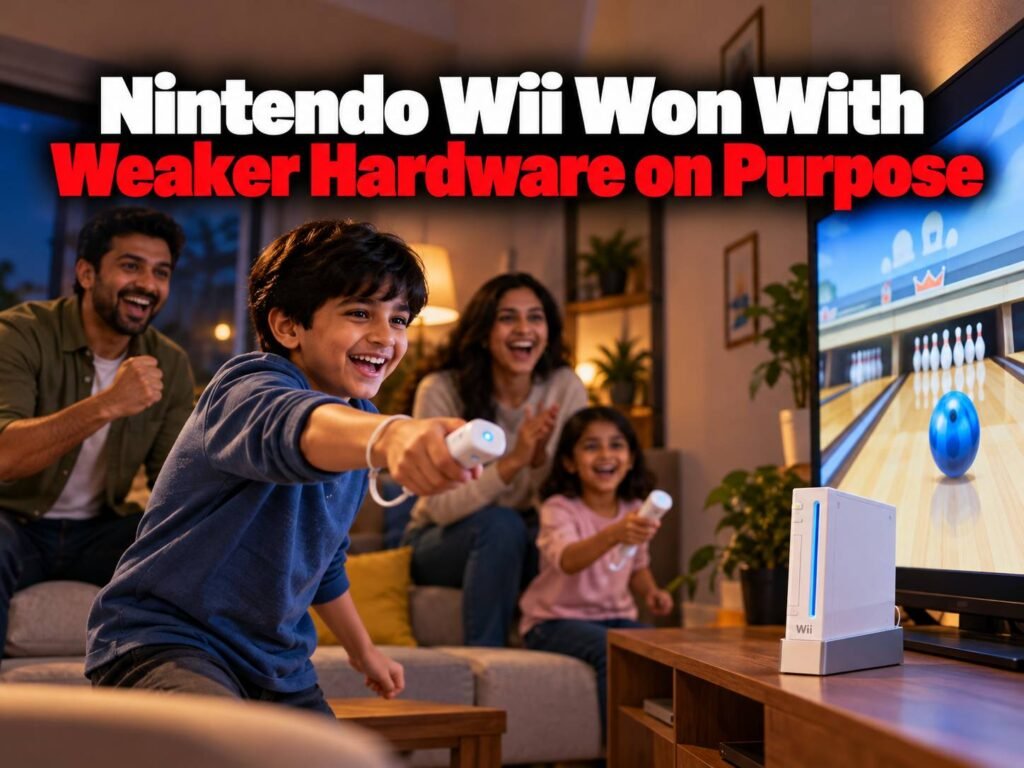
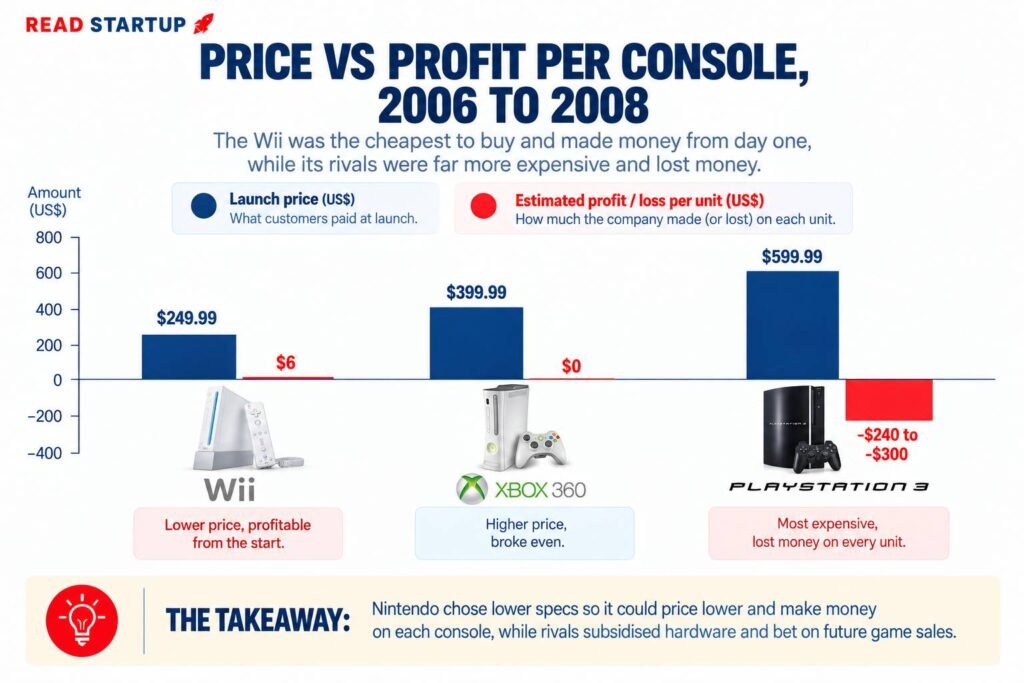
Just imagine a shop aisle in late 2006. Sony's top PlayStation 3 carried a $599.99 price tag. A few shelves away sat the Nintendo Wii at $249.99 with Wii Sports in the box.
Every gaming site could see the Wii was the weaker machine. Fewer people looked at the money. Analysts estimated Sony was losing $240 to $300 on every PS3 it shipped, while Nintendo booked a profit on each Wii.
This one gap explains almost everything that came next.
The arms race had a brutal entry fee
Console makers back then ran a razor-and-blades model. You sell the hardware below cost, then claw it back through game royalties over five or six years. The math works, but only for a player who can survive the early burn.
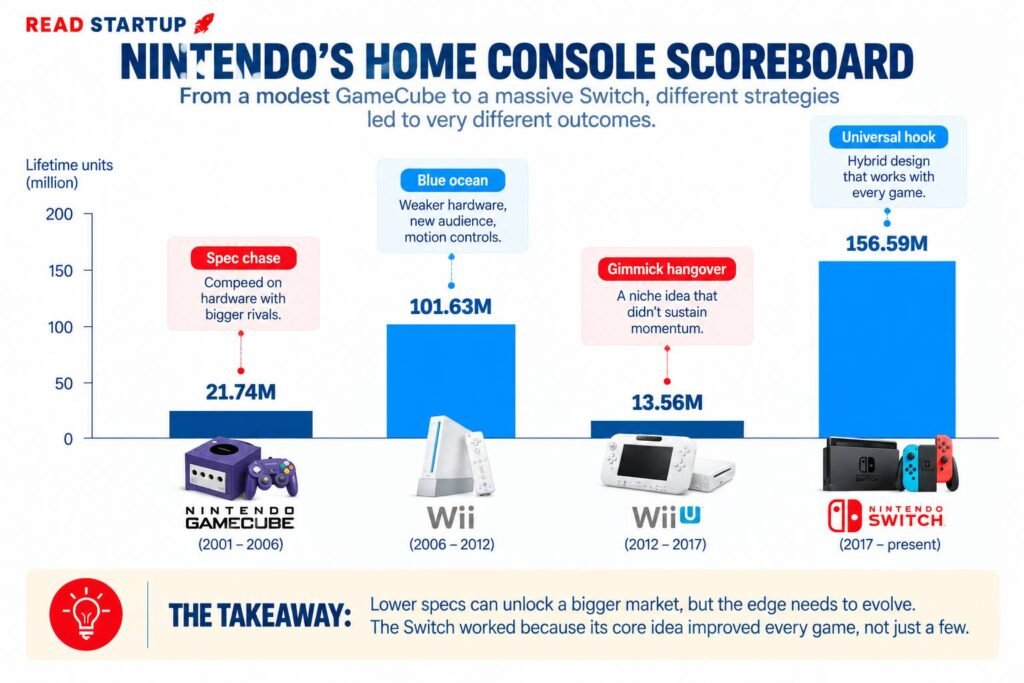
Nintendo had just lost that fight. The GameCube sold 21.74 million units in its lifetime, a distant also-ran next to the PS2. Chasing Sony on specs again meant paying a premium to join a war it was already losing.
So Satoru Iwata changed the goal. In a 2006 briefing, he said Nintendo's target was expanding the total number of people who play games. The scoreboard moved from polygon counts to living rooms.
Pick the customer first, then the spec sheet
Once the target became your mum, your grandad, and the friend who "doesn't do games," the product brief rewrote itself. That buyer cared about price, a controller they could understand in ten seconds, and something fun in the first five minutes.
The Wii Remote solved the controller. Wii Sports solved the first five minutes. Older, cheaper silicon solved the price, and it kept the console small and quiet enough to sit next to the TV without a fuss.
Iwata later explained the logic plainly. A blue ocean strategy, he said, means focusing hard on one area by abandoning some good ideas on purpose. HD graphics was one of those good ideas. Nintendo left it on the table because its chosen customer would never pay for it.
Positive unit economics bought freedom
Making money on hardware from launch rewired Nintendo's risk profile. A Macquarie analyst put the figure at around $6 of operating profit per Wii, while Microsoft only broke even on the Xbox 360 and Sony was still underwater.
Six dollars sounds tiny. What matters is the sign in front of it. Every new Wii owner made Nintendo stronger on day one, so it could ship aggressively and keep marketing to brand-new audiences without watching the burn rate.
Software margins stacked on top. The same analysis found Nintendo's own titles made up about 60% of Wii games sold, against 15% for Sony's first-party games on PS3. Nintendo owned the box and the hits inside it.
The scoreboard at the end: the Wii finished at 101.63 million units, close to five times the GameCube.
The bill arrived a few years later
A blue ocean wins the first lap. After that, the water starts changing color.
Big publishers built their flagship games for PS3 and Xbox 360, and the Wii's hardware made porting painful. Casual buyers who came for Wii Sports often stopped buying new games after a few months. Annual Wii sales peaked at about 26 million units in Nintendo's fiscal year to March 2009, then slid, as Fortune noted in 2012.
The Wii U inherited that hangover. Nintendo forecast 9 million Wii U sales for the year to March 2014 and sold just 2.72 million. The new audience never came back for round two, and core gamers had already moved on.
What the Switch fixed
Nintendo kept the affordable-hardware playbook. It repaired the part that broke.
The Switch still ran on mature mobile chips. The difference was the hook. A console you can lift out of the dock and carry onto a train improves every single game, from Zelda to a tiny indie platformer. The Wii Remote only helped games designed around waving your arm.
Nintendo's own Switch 2 producer, Kouichi Kawamoto, has said the team now prioritises features that work with any kind of software over hardware tricks that suit a handful of titles. That one design rule pulled third-party developers back, and the Switch has now passed 156 million units.
Founder takeaways
If you are a founder yourself, you might find the following useful for your business:
Change the scoreboard before you change the product. Nintendo stopped measuring itself on graphics and started measuring how many new people played. List the metric your bigger rivals obsess over, then find the customer who doesn't care about it at all.
Make your first unit profitable if you can. Positive contribution margin from day one gives a challenger room to price aggressively and experiment. Subsidy models favour whoever can outlast the burn, and that is rarely the startup.
Cut good features on purpose. HD was a sensible idea that Nintendo dropped because its target buyer would never pay for it. Your roadmap deserves the same discipline.
Plan the second lap early. Pick differentiation that improves every product and partner on your platform. An edge that only helps one use case gives rivals and time an easy way to close the gap.
More breakdowns
How Costco Earns Before You Walk In
The most profitable product in every warehouse is a plastic card at the door

The Thin Margins Behind Every Pathao Ride
The ride that fit Dhaka perfectly was never where the profit lived

How Jio Rewired a Billion-Person Market
The giveaway that shrank India's telecom market is now heading for a record IPO