The ride that fit Dhaka perfectly was never where the profit lived
At a glance
- The move Putting Dhaka's commuters on the back of strangers' motorbikes
- The puzzle The ride that fit Dhaka perfectly was never where the profit lived
- The takeaway How to tell product-market fit apart from a business that actually earns
The 100-taka pitch outside a Banani campus
In 2016, Hussain M Elius and his team stood outside universities in Banani offering students something that sounded slightly mad: a motorbike ride anywhere for 100 taka. Bangladesh had no habit of climbing onto a stranger's bike. By the fourth day, students were phoning to book.
Dhaka ranks among the world's ten most road-congested cities, and a motorbike slips through gaps a car never will. Product-market fit arrived almost overnight. The business model took the better part of a decade to catch up.
Fit that needed no pitch deck
Pathao began in 2015 as a courier service for Facebook sellers. The founders noticed their delivery riders sat idle at midday while commuters sat in gridlock, so they tested rides with a handful of bikes, a phone number, and a spreadsheet before writing much code.
Demand was obvious from day one. A Policy Research Institute study found a Pathao bike moved at about 16 km an hour through Dhaka, against 12 for a car, and cost under Tk 150 a trip, well below a CNG auto-rickshaw. By 2018, a Go-Jek-led round valued Pathao at more than $100 million.
Strong fit tells you people want the product. It says nothing yet about whether each sale makes money.
The math on a single ride
After the August 2022 fuel price hike, Pathao raised its bike fare to Tk 15 per kilometre. In late 2021 it had already cut its bike commission to 10% at peak hours and up to 15% off-peak, and bikers still describe a cut of roughly 15% in 2026.
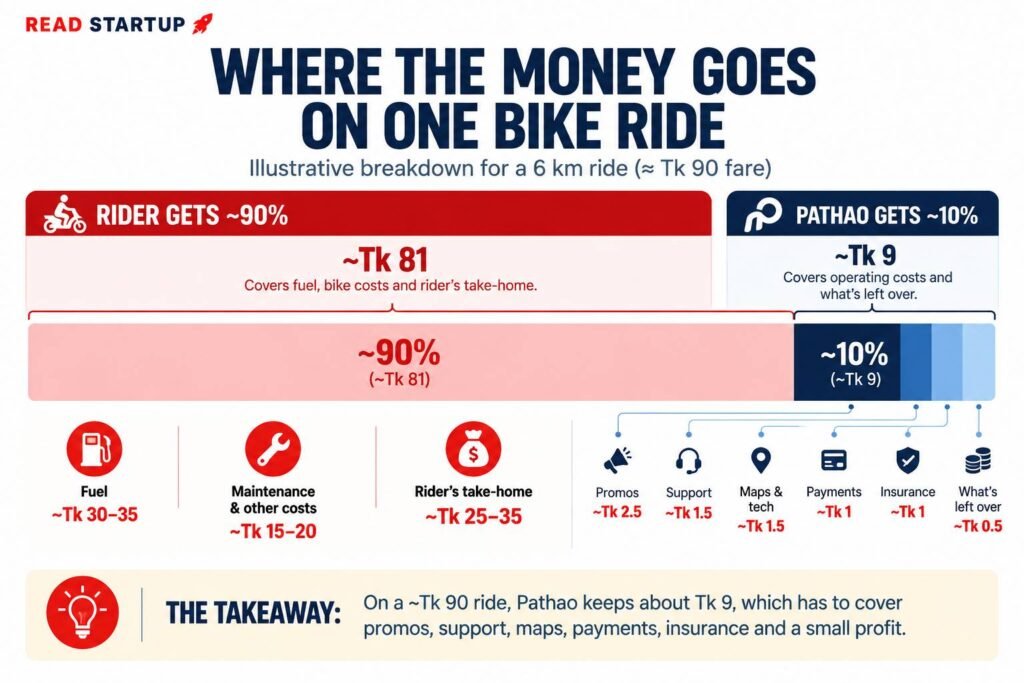
Run a rough, illustrative example. A 6 km ride works out to around Tk 90 plus a base fare, and a 10% cut leaves Pathao somewhere near Tk 10.
That ten taka has to cover promo codes, customer support, maps, payment processing, rider insurance, compliance, and a slice of marketing. The rider, meanwhile, pays for fuel, maintenance, and the bike itself. Both sides of the marketplace are working on thin margins, which leaves very little room for mistakes.
In startup terms, you have a small average order multiplied by a low take rate, the slice of each fare the platform keeps. Contribution margin, the money left from each ride after its direct costs, only turns positive with heavy volume and almost no discounting.
The leak called khep
A ride-hailing app does its most valuable work in the first two minutes, when it matches a passenger with a rider. After that, the two people are standing next to each other with a bike and a destination.
Dhaka's riders have a word for what happens next. Many switch the app off and agree to a fare directly, which drivers use to skip the commission. A driver union leader complained to Rest of World about paying commissions of up to 25% while covering every running cost.
The industry calls this disintermediation, which simply means cutting out the middleman, and it hits hardest where the service is simple and repeatable. Pathao and Uber responded by piloting driver subscriptions priced from 30 to 450 taka, covering one to 30 days with no per-ride commission. The lesson runs deeper than pricing: a platform keeps its cut only when it adds value after the match, through safety, insurance, dispute handling, or guaranteed demand.
Ten verticals on a thin base
Around 2018, the super-app dream arrived. Elius later wrote that at its peak, Pathao ran ten separate verticals, including Pathao TV, each with its own team and roadmap.
Every new vertical pulled engineers and attention away from the booking experience that actually paid the bills. Marketing ran hot too: internal records reported by The Daily Star showed Tk 25 million spent on branding and PR in January 2019 alone, with no clear lift in daily rides.
A core product earning around ten taka a trip could not fund that many bets. Later that year the company restructured and cut more than 300 jobs.
Where the margin actually lives
Fahim Ahmed, the former CFO, became CEO in November 2021 and narrowed the focus to courier, rides, and food. Side projects like Pathao TV were shut, and cash bonuses for drivers that the business couldn't sustain were dropped. By its September 2024 round, Pathao said it had been
profitable for two years and had raised over $50 million in total.
The growth bet now sits in fintech. Its Pay Later product became grossly profitable using machine-learning underwriting.
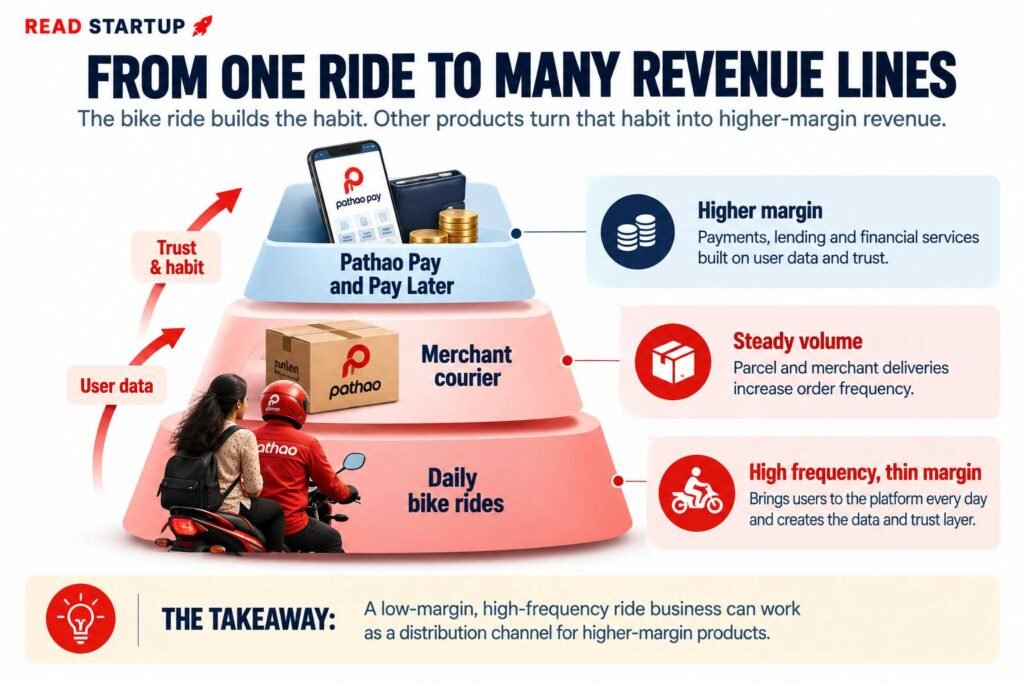
Look at how the pieces fit together. The bike ride builds a daily habit, trust, and a mountain of user data. Merchant parcels and credit products turn that habit into margin. The ride works as the distribution channel, and the thicker-margin products do the earning.
Founder takeaways
If you are a startup owner, here are some quick takeaways:
- Separate fit from economics. Track contribution margin per order after promos and support, right alongside your growth numbers.
- Measure your leakage rate. If users can complete the deal without you, estimate how many already do.
- Add value after the match. Safety features, insurance, and payment protection give people a reason to stay on the app once the handshake is done.
- Earn the right to add verticals. Get your core product to positive unit economics before you split the engineering team ten ways.
- Use the habit as distribution. A low-margin, high-frequency product can carry higher-margin products once the core runs lean.
More breakdowns
Nintendo Wii Won with Weaker Hardware on Purpose
The weakest box of its generation outsold both rivals and made money from day one

How Costco Earns Before You Walk In
The most profitable product in every warehouse is a plastic card at the door

How Jio Rewired a Billion-Person Market
The giveaway that shrank India's telecom market is now heading for a record IPO