The giveaway that shrank India's telecom market is now heading for a record IPO
At a glance
- The move Giving away a brand-new 4G network to an entire country for months
- The puzzle The giveaway that shrank India's telecom market is now heading for a record IPO
- The takeaway A four-part test for when subsidized growth can actually work
The day data stopped being expensive
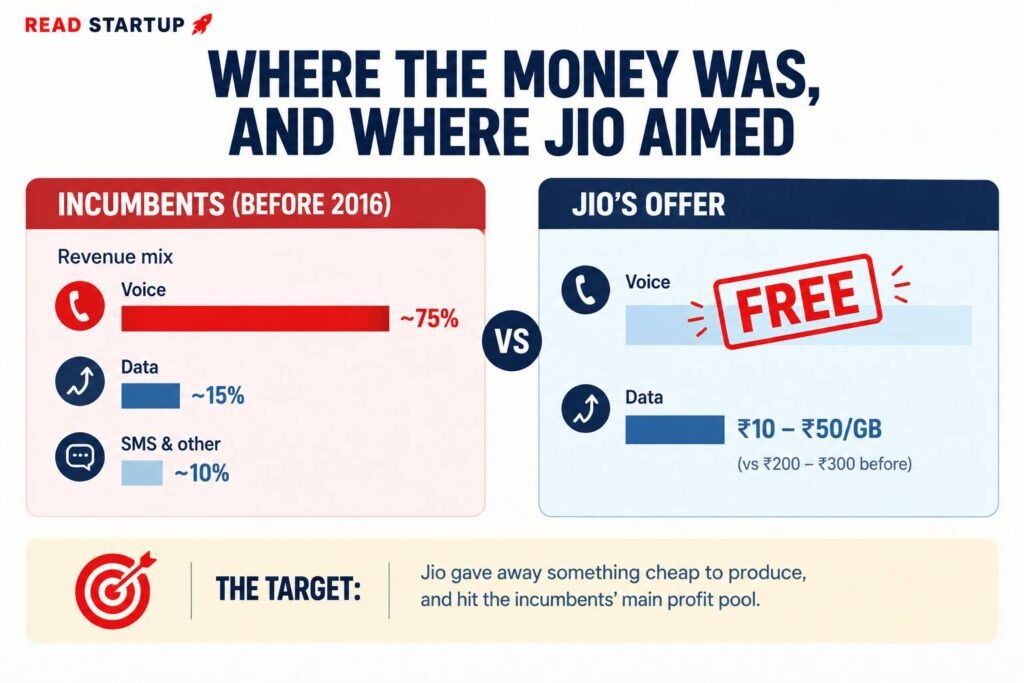
Before September 2016, a gigabyte of mobile data in India cost somewhere between ₹200 and ₹300. Then Mukesh Ambani switched on Reliance Jio and handed out calls and data for free for months.
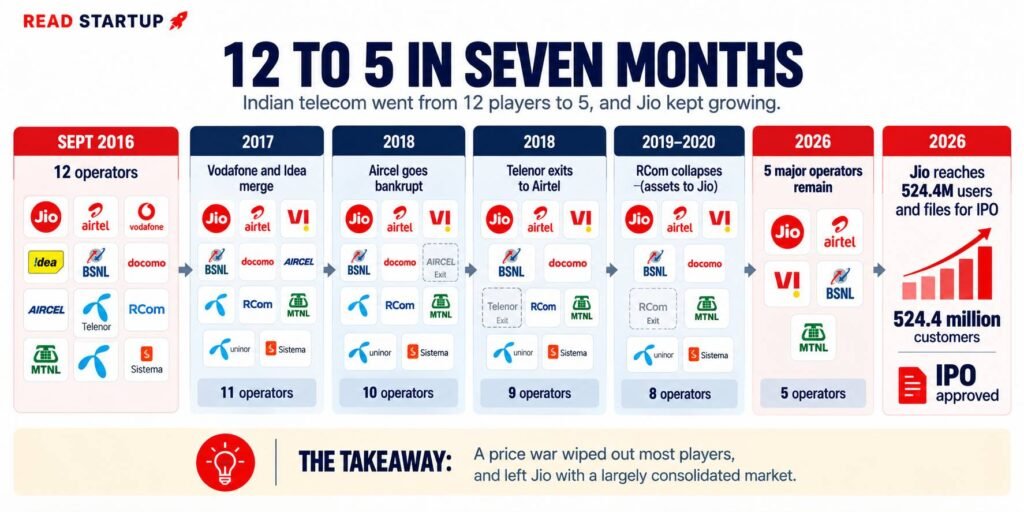
Jio signed up 100 million subscribers in 170 days. Over the same stretch, India's monthly mobile data use jumped from 200 million GB to more than 1 billion GB. A dozen operators watched their customers walk out, and within two years the market looked nothing like the one Jio entered.
Free, aimed at the incumbents' wallet
The clever part of Jio's offer was what it chose to give away. Indian telecom had a long run on voice, with calls bringing in about 75% of the industry's earnings. Jio made domestic voice calls free for life.
For Jio, that promise cost very little. It ran a 4G-only network where a phone call travels as a tiny stream of data, so each extra minute added close to nothing to its costs. The incumbents ran older 2G and 3G networks and priced by the minute.
The same "free" therefore landed very differently on each balance sheet. Jio gave away something cheap to produce, and its rivals lost the product that paid their bills. A subsidy aimed at precisely behaving like a missile with a discount label on it.
A price war funded by a refinery
Reliance Industries made its fortune in petrochemicals, and that cash is what paid for the war. Jio spent around ₹1.5 lakh crore on towers, fibre and spectrum before customers paid a single rupee.
Its rivals were standalone telcos carrying debt, answerable to shareholders who wanted dividends. They could match Jio's prices for a quarter or two. Matching them for years meant burning through money they didn't have.
When the free period ended, Jio priced data at roughly ₹10 to ₹50 per GB, over 90% below the old market rate. It also billed on 28-day cycles, which quietly squeezes 13 bills out of every year. Small pricing details like that matter a lot when your margin per user is thin.
The market that shrank
India had 12 telecom providers just before Jio launched, and only five remained seven months later. The consolidation kept going from there. Vodafone and Idea merged, Aircel went bankrupt, Telenor sold to Airtel, and Reliance Communications collapsed, with Jio picking up its assets.
Then came a twist worth remembering. Once the field had thinned out, Jio itself proposed a minimum price of ₹15 per GB to the regulator. The company that broke prices went on to ask for a price floor. Market-share wars end with a winner who suddenly loves stability.
Where the money finally showed up
In 2020, during the first wave of COVID-19, Jio Platforms raised over ₹1.52 lakh crore from investors, including Meta and Google. Big tech was buying a seat on India's biggest distribution layer for digital services.
By March 2026, Jio served 524.4 million customers and reported ₹30,049 crore in profit after tax for the year. SEBI cleared its IPO documents on August 28, 2026, and the listing is expected to rank among India's largest ever.
Seen from here, the free launch was a customer acquisition cost. Reliance paid it once, at a national scale, and then spent a decade selling everything else to those customers.
Why this almost never works for a startup
Founders love this story, and plenty have tried a small version of it with free delivery, free trials, or 90% off launch promos. Jio's version worked because four conditions lined up at once.
- First, the money came from a parent with profits elsewhere, so Jio's runway (how long it could keep spending before the cash ran out) outlasted the pain threshold of every rival.
- Second, marginal cost, the extra cost of serving one more user, was near zero once the network existed. Third, the free product hit the competitors' main profit pool far harder than it hit Jio's. Fourth, a paid product sat waiting at the end, with the SIM, the number, and the daily habit already in the customer's hands.
A seed-stage startup usually has none of these. Its runway is set by the next funding round, each order carries real delivery or support costs, and bigger rivals can match any discount for longer. When the subsidy stops, users who came for "free" tend to leave with it.
Founder takeaways
If you have a startup like Jio, here’s what you need to know:
- Subsidise where your costs are lowest. Give away the thing that's cheap for you to produce and expensive for incumbents to lose.
- Measure runway against your rival's pain. A subsidy only works if you can keep it going after competitors run out of patience or cash.
- Design the paid step before launch day. Jio knew exactly which plans free users would move into and when.
- Expect the rules to change after you win. Pricing floors, regulators, and public scrutiny arrive right when dominance does.
- Run the "switch it off" test. Estimate how many users would stay if your discount vanished tomorrow, and treat that number as your real retention.
More breakdowns
Nintendo Wii Won with Weaker Hardware on Purpose
The weakest box of its generation outsold both rivals and made money from day one

How Costco Earns Before You Walk In
The most profitable product in every warehouse is a plastic card at the door

The Thin Margins Behind Every Pathao Ride
The ride that fit Dhaka perfectly was never where the profit lived