Dynamic pricing examples from Uber surge pricing, airline fares, Ticketmaster and the Wendy's backlash. Why the same mechanism earns trust in one market and anger in another.
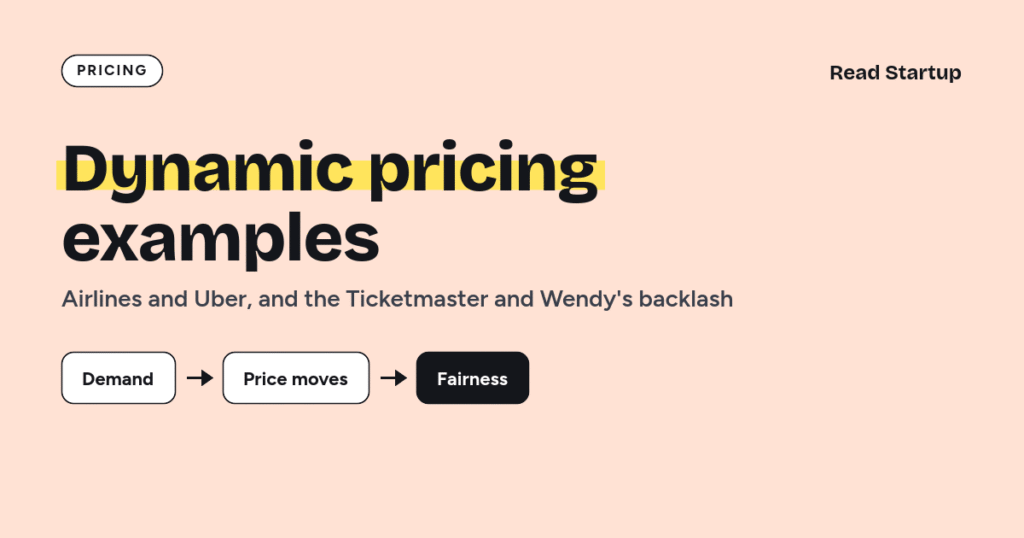
Dynamic pricing changes prices as demand and supply change. Airlines have done it for decades, Uber made surge pricing visible to everyone, and Ticketmaster and Wendy’s found out how fast it can turn customers against a brand.
This page is part of Read Startup’s pricing case studies and one of the types of pricing strategies. It compares where dynamic pricing was accepted and where it backfired, and ends with a fairness test.
What is dynamic pricing?
Dynamic pricing is a strategy where a company adjusts prices frequently, often automatically, based on demand, supply, time or customer data. It aims to match price to willingness to pay and to balance supply and demand.
The problem it solves is that fixed prices are wrong most of the time: too high when demand is low, so capacity sits empty, and too low when demand peaks, so the product sells out to whoever is fastest. Surge pricing is the best-known form, where prices jump during a short spike. The risk is that customers judge the result not by economics but by fairness.
How does dynamic pricing work?
An algorithm raises prices when demand outruns supply and lowers them when capacity sits idle. In marketplaces it also pulls in more supply, such as more drivers during a surge.
- Demand signals and price rules. Inputs such as seats left, time to departure, local requests or weather feed rules that set the price.
- Supply response in marketplaces. In a two-sided market, a higher price does two jobs: it reduces demand and it attracts more sellers, such as drivers who log on during a surge.
- Perceived fairness and transparency. Customers accept higher prices more readily when they can see why, and when they had the option to book earlier.
- Regulatory limits. Price-gouging laws in many places limit how far prices can rise during emergencies.
Which companies used dynamic pricing, and how did customers react?
Airlines and hotels show accepted dynamic pricing, Uber shows it balancing a two-sided market, and Ticketmaster and Wendy’s show the trust cost when customers read it as gouging.
| Company | What moved the price | Customer reaction | Source |
|---|---|---|---|
| Airlines | Seats left and days to departure | Accepted as normal | Industry practice |
| Uber | Ride requests vs drivers nearby (surge) | Accepted, with complaints at peaks | Company design; press |
| Ticketmaster | “Official Platinum” prices for in-demand seats | Backlash, July 2022 | Press coverage, July 2022 |
| Wendy’s | Talk of “dynamic pricing” on an earnings call | Backlash; walked back, February 2024 | Company statement, Feb 2024 |
Airlines: fares that move with seats left and days to departure
Airlines price each flight by how many seats are left and how close the date is. A seat bought months ahead costs less than the same seat bought the day before. Customers rarely protest, because the rule is familiar and anyone can book early to get a lower fare.
Uber: surge pricing to pull more drivers onto the road
Uber raises fares when ride requests outnumber drivers nearby. The higher fare is meant to cut demand and bring more drivers online at the same time. Customers see the multiplier before they book, which helps, but surges during storms or emergencies still draw complaints. That is the price lever inside a two-sided marketplace.
Ticketmaster: “Official Platinum” prices for concert tickets
Ticketmaster’s “Official Platinum” programme lets prices for in-demand seats rise with demand. In July 2022, some tickets for Bruce Springsteen’s 2023 tour were listed at several thousand dollars, and fans and press reacted angrily. The mechanism worked as designed; the reaction showed that fans see concert tickets as something that should be fair, not auctioned.
Wendy’s: a 2024 plan described as surge pricing, then walked back
In February 2024 Wendy’s chief executive mentioned plans to test “dynamic pricing” on its digital menu boards. Headlines called it surge pricing on burgers, and customers objected. Within days Wendy’s said it would not raise prices at the busiest times and that any changes would be discounts at quieter times. A fast-food meal is seen as a fixed-price staple.
When does dynamic pricing fail?
Dynamic pricing fails when customers feel exploited at moments of need, when prices are opaque, or when the product is seen as a fixed-price staple such as a fast-food burger.
- Moments of need. A price spike during a storm, an emergency or a festival looks like exploitation, however sound the supply logic.
- Opaque prices. If customers cannot see why a price changed, they assume the worst.
- Fixed-price staples. Products customers think of as having one fair price, like a burger or a concert ticket, carry the highest backlash risk.
- Revenue without supply. When surge pricing only raises margin and does not bring more supply, it is hard to defend.
How does ride-hailing surge pricing play out in South Asia?
Ride-hailing apps in Dhaka apply surge pricing at peaks such as Eid, when riders have publicly complained about fares, as The Daily Star reported in 2019. Festival spikes test whether surge pricing is seen as fair.
Surge complaints during Eid in Dhaka
Before and after Eid, millions of people travel in and out of Dhaka in a few days, and demand for rides spikes. During the 2019 Eid holidays, Uber users in Dhaka complained of surge fares, according to The Daily Star. The same mechanism that pulls in drivers on a rainy evening looks very different during a religious holiday, when riders have no choice about when to travel. Local rivals such as Pathao face the same test. Festival peaks are where fairness matters most, which is why a cap on peak multipliers at those moments can protect trust more than it costs in revenue.
How can you use dynamic pricing without a backlash?
Explain price changes before checkout, cap peaks at essential moments, use dynamic pricing to add supply rather than only extract margin, and track complaints alongside revenue.
- Explain price changes before checkout. Show the reason and the multiplier before the customer commits.
- Cap peaks for essential moments. Set maximum increases for emergencies, holidays and other times customers cannot avoid.
- Use surges to add supply. A higher price that brings more drivers or seats is easier to defend than one that only raises margin.
- Monitor complaints alongside revenue. Track complaints, cancellations and social mentions as closely as you track revenue per unit.
Frequently asked questions about dynamic pricing
What is dynamic pricing?
Dynamic pricing is changing prices frequently, often automatically, in response to demand, supply, time or customer data. Airline fares, hotel rates and Uber’s surge pricing are common examples. It aims to fill capacity when demand is low and capture more when it peaks.
How does Uber surge pricing work?
When ride requests in an area outnumber available drivers, Uber raises fares by a multiplier shown before booking. The higher fare reduces demand and encourages more drivers to go online, until supply and demand balance and the surge falls.
Is dynamic pricing legal?
Generally, yes, but price-gouging laws in many places restrict price rises on essentials during emergencies, and charging different prices based on protected characteristics can be unlawful. Check local rules; this is not legal advice.
What is the difference between dynamic pricing and price discrimination?
Dynamic pricing changes the price for everyone as conditions change over time. Price discrimination charges different customers different prices for the same thing at the same moment. The two often overlap when prices are personalised.
Why did Wendy’s back off dynamic pricing?
In February 2024 comments about testing dynamic pricing were read as surge pricing on burgers. After customer backlash, Wendy’s said it would not raise prices at peak times and would use any changes for discounts at slower times.
Before prices move with demand, run the four fairness checks above. Usage that tracks customer value belongs in value-based pricing instead. Browse the pricing case studies, or get one company decision broken down twice a week.
By the Readstartup Team. Events are dated and attributed to their source; corrections are logged on our Corrections Policy page.
More guides
Transparent Pricing Examples: Companies That Won by Exposing Hidden Fees
Transparent pricing examples from Wise, Southwest Airlines and Costco: how showing the real price beat rivals who relied on hidden fees, and what it…
Premium Pricing Examples
Premium pricing examples from Hermès, Apple, Liquid Death and Patagonia: how brands hold high prices permanently, and what keeps a premium from collapsing into…
Decoy Pricing Examples
Decoy pricing examples from The Economist experiment, cup sizes, popcorn and SaaS pricing pages: how a third option steers choice, and how to tell…