The most profitable product in every warehouse is a plastic card at the door
At a glance
- The move Capping its own markups on almost everything it sells
- The puzzle The most profitable product in every warehouse is a plastic card at the door
- The takeaway How to price access so your core product can stay cheap
The most profitable item in the warehouse
In fiscal 2025, Costco sold $269.9 billion worth of stuff. This included groceries, tires, flat-screen TVs, and even those famous $5 rotisserie chickens.
Then came the bills. Costco paid for the goods, the staff, and the warehouses. But what was left over was a tad bit surprising.
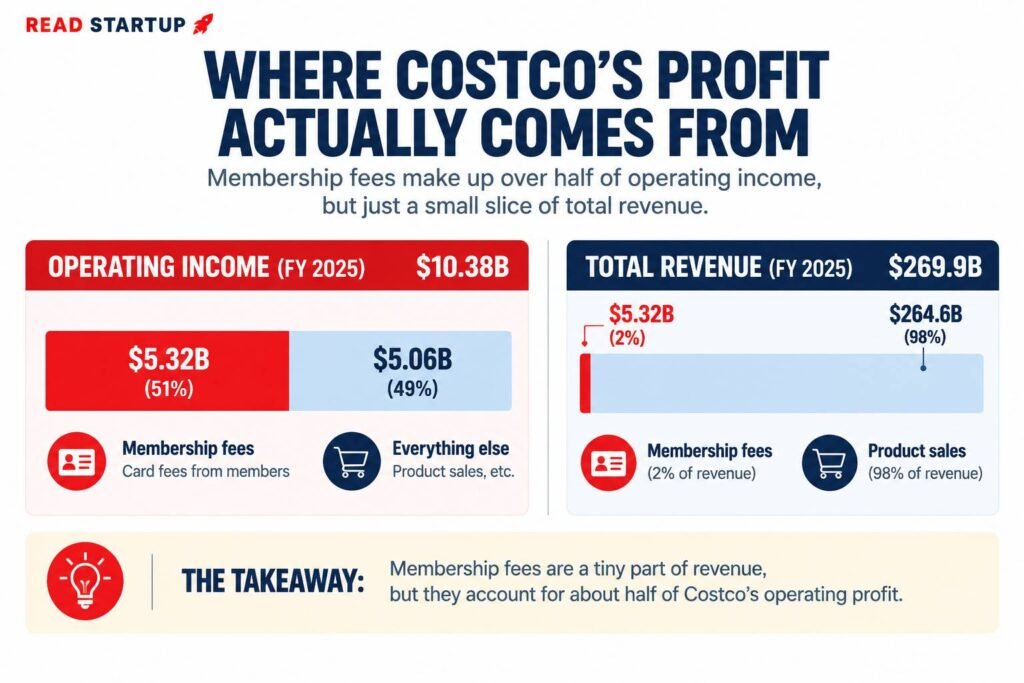
The money that carried the year came from somewhere else. Membership fees brought in $5.32 billion. That covered about 51% of Costco's $10.38 billion operating income. Sit with that for a second. Roughly half the profit of the world's biggest warehouse club comes from a plastic card. People buy it once a year at the front door, usually without a second thought.
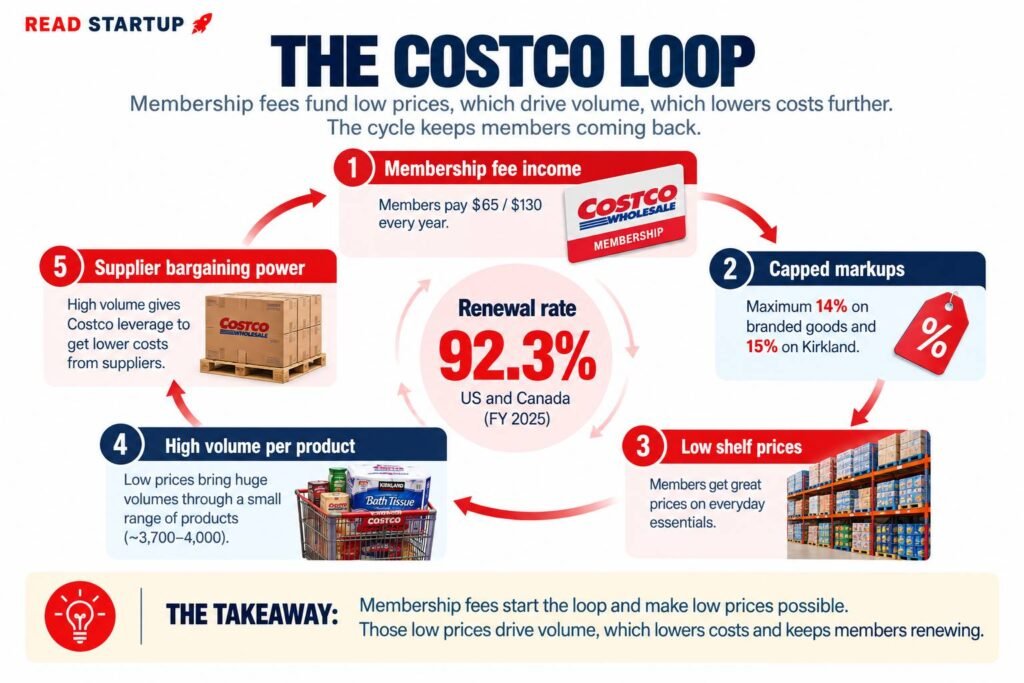
A typical grocer adds a 20 to 25% markup to what it pays suppliers. Costco plays by a stricter rule. Co-founders Jim Sinegal and Jeff Brotman wrote a hard ceiling into the business. Today, markups still cap at 14% on branded goods and 15% on Kirkland Signature.
Sinegal guarded that ceiling like a family rule. He held the line even when it looked like free money walking out the door.
The best example involves a pile of jeans. A batch of Calvin Klein jeans once arrived cheaper than expected. They were already flying off the tables at the old price. Sinegal cut the price anyway.
Imaging the finance team watching that happen. Inside Costco, though, a cut like that counts as marketing spend. It pays off later, on the one day that matters most: the day a member decides whether to renew.
The real product is the right to shop
Since September 2024, a Gold Star membership costs $65 a year and Executive costs $130. The fee carries almost no cost of its own. There's no inventory to hold, no shelf to stock, and nothing to spoil.
The cash also lands up front and gets recognized over twelve months. This gives Costco something retailers barely get to enjoy: predictable, recurring revenue.
In startup terms, Costco runs a subscription business (a lot like Netflix, where you pay for access every year) with a very large fulfillment layer attached. The warehouse delivers the value, and the card captures it.
Members stick around, too. At the end of fiscal 2025, Costco reported a renewal rate of 92.3% in the US and Canada and 89.8% worldwide across 81 million paid memberships. Any software founder would frame that churn rate, the share of customers who leave each year, and hang it on the office wall.
Why the markup cap protects the fee
Every member runs a quiet return-on-investment check each year, weighing what the card saved them against what it cost. The markup cap keeps that answer comfortably positive. If prices crept up a few points, members would start comparing receipts with Walmart, and a comparison habit is poison for a renewal business.
So the cap works as a self-imposed constraint that makes the fee easy to pay. Costco gives up margin on each basket to protect the one payment that carries the profit.
The executive tier shows how neatly this sorts customers. Executive members get 2% back on purchases, so the upgrade only pays off for heavy shoppers. The result is damn clear as well. Executive members make up 47.7% of paid members yet drive 74.2% of worldwide sales. Nobody had to be profiled or targeted, because the big spenders picked the pricier card themselves.
The loop that pays for low prices
Fee income lets Costco run on thin margins. Thin margins mean low prices. And low prices pull in huge volume.
But the clever bit is, all that volume flows through a tiny range of products, roughly 3,700 to 4,000 per warehouse. A typical supermarket stocks many times that.
So Costco sells mountains of each item. This gives them serious muscle when it sits down with suppliers. Costs drop, and the savings go straight back into prices. Then the whole cycle starts again.
The same loop explains why Costco gets by without a traditional ad budget. Think about how it works for a member. You've already paid for the card, so you come back on your own. Every trip quietly reminds you the card was worth it.
The money a rival spends on billboards ends up in Costco's shelf price.
Where the model bends
But just like every other thing in this world. This model too has a soft spot, and it showed up in 2025. Worldwide renewal dipped from 90.2% to 89.8% in the final quarter, and management pointed to a rising share of online sign-ups, including a large Groupon promotion.
Now, think about it for a minute. A discounted channel lowered CAC (customer acquisition cost, what you spend to win one customer) and brought in younger members. Those cohorts renewed less often, which cut their LTV, the total a customer pays you over the whole relationship. So, cheap acquisition bought weaker customers.
The fee hike tells a happier story about pricing power. The 2024 increase was Costco's first in seven years, and paid memberships still grew. When raises come rarely, members read them as fair.
Borrowing the playbook
The model travels well when customers buy often and can judge quality with their own eyes within a few visits. That describes plenty of businesses much closer to home than Seattle.
A local wholesale supplier could charge cafés a monthly fee for near-cost coffee beans and dairy. A B2B parts marketplace could sell an annual pass with capped margins on consumables. Any business built on repeat, comparable purchases can move its profit from the transaction to the relationship.
It struggles where results take months to show or are hard to measure. People only renew for savings they can feel.
Founder takeaways
If you have your own startup, here are some things to keep in mind:
- Price the relationship first. Put your profit in a recurring fee and let the core product run close to cost as your acquisition engine.
- Write your margin ceiling down. Costco's cap has lasted four decades because it lives in writing as a rule the team follows, whatever the quarter looks like.
- Track renewal by acquisition channel. A promo that fills the top of the funnel can quietly drag down your retention curve.
- Let your tiers sort your customers. A premium plan with rewards tied to spend pulls your best buyers upward without a single sales call.
- Raise the fee rarely. Pricing power behaves like a battery, so spend it every few years and recharge it with visible value in between.
More breakdowns
Nintendo Wii Won with Weaker Hardware on Purpose
The weakest box of its generation outsold both rivals and made money from day one

The Thin Margins Behind Every Pathao Ride
The ride that fit Dhaka perfectly was never where the profit lived
How Jio Rewired a Billion-Person Market
The giveaway that shrank India's telecom market is now heading for a record IPO