Bundle pricing examples from Microsoft Office, Amazon Prime, streaming bundles and Jio. Why bundles beat better standalone products and when they backfire.
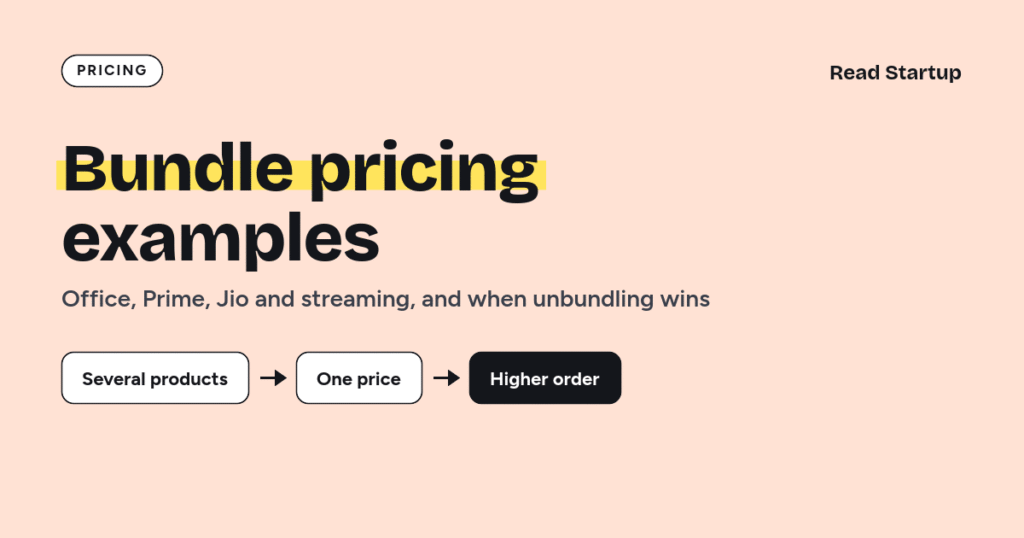
Bundle pricing sells several products together for less than their separate prices. Microsoft Office beat strong standalone apps this way, Amazon Prime keeps adding perks to one fee, and Jio bundled data, calls and apps.
This page is part of Read Startup’s pricing case studies and one of the types of pricing strategies. It covers why bundles work, four companies that won with them, and when unbundling wins instead.
What is bundle pricing?
Bundle pricing sells two or more products as a package at a lower combined price than buying each separately. It raises average order value and makes it hard for single-product competitors to compete on price.
A bundle changes the comparison a customer makes. Instead of weighing your word processor against a rival’s, they weigh your whole suite against one rival app plus the cost of buying everything else separately. A single-product competitor can be better at its one thing and still lose, because it has to match a price that covers several products.
How does bundle pricing work?
Bundles work because customers value the parts differently; one price captures more total willingness to pay, and in software and media the extra items often cost little to add.
- Pure vs mixed bundling. Pure bundling sells only the bundle. Mixed bundling sells the bundle and the parts, so customers can still buy one item alone at a higher unit price.
- Low marginal cost of digital add-ons. Adding one more app or one more show to a digital bundle costs the seller very little, so the bundle can grow without its cost growing much.
- Uneven valuations. One customer values the spreadsheet most, another the slides. Priced separately, each buys one item; bundled at one price, both buy everything, and the seller captures more of what each would pay.
- Bundles as a competitive weapon. A rival that sells one product must compete with your bundle’s price, not your product’s price.
- Perceived savings. Showing the separate prices next to the bundle price makes the bundle feel like a deal, even for buyers who would not have bought every part.
Which companies won with bundle pricing?
Microsoft Office beat strong standalone apps by selling the suite; Amazon Prime keeps adding perks to one fee; Jio packaged data, calls and apps; streaming bundles combine services to reduce churn.
| Company | Bundle | What it achieved |
|---|---|---|
| Microsoft Office | Word processor, spreadsheet, slides and email in one suite | Beat strong standalone rivals in each category |
| Amazon Prime | Fast shipping plus video, music and other perks for one fee | Made the fee feel like more than shipping |
| Reliance Jio | Data, voice calls and Jio apps in one plan | One simple plan instead of separate charges |
| Streaming bundles | Several services sold together at a discount | Lower churn than single services |
Microsoft Office: the suite that beat strong standalone apps
In the early PC era, the best word processor, spreadsheet and presentation tools came from different companies. Microsoft sold them together as Office, at a price close to what one standalone app cost. Rivals that were strong in a single category had to compete with a whole suite, and buyers who needed two or three tools found the bundle the obvious choice.
Amazon Prime: shipping, video and music for one fee
Amazon Prime began in 2005 as a shipping membership and has since added video, music and other perks to the same fee. Each addition makes the fee easier to justify and harder to cancel, because a member who stops using one perk still uses another. See our membership pricing examples for how the fee itself works.
Reliance Jio: data, calls and apps in one plan
When Jio launched in India in 2016, it sold data with voice calls and its own apps in a single plan, rather than charging separately for calls and data as incumbents did. The bundle made the offer simple to compare and hard to match. Read how Jio rewired a billion-person market.
Streaming bundles: services combined to reduce churn
Streaming services lose subscribers who sign up for one show and leave. Selling several services together at a discount gives each subscriber more reasons to stay, so bundles are used to cut churn as much as to win new customers.
When does bundle pricing fail?
Bundles backfire when customers pay for parts they do not want, which opens the door to unbundled challengers, and when regulators treat tying as anti-competitive, as with Microsoft unbundling Teams in Europe in 2023.
Tying is when a company with a dominant product makes buying it conditional on buying another. In 2023, under European Commission scrutiny that followed a complaint from Slack, Microsoft began selling its Microsoft 365 and Office 365 suites without Teams in the European Economic Area. On 12 September 2025 the Commission accepted Microsoft’s commitments to keep offering suites without Teams and made them binding, closing the case without a fine. A bundle that helps a small company compete can become a legal problem for a dominant one.
The other failure is commercial: if most buyers want one part and resent paying for the rest, the bundle invites a challenger that sells just that part.
When does unbundling win instead?
Unbundling wins when one part of a bundle can be done much better alone and customers resent paying for the rest. Streaming against cable, and Canva against full design suites, are the clearest cases.
- Cable TV vs streaming. Cable sold hundreds of channels for one bill. Netflix sold one service that did on-demand viewing far better, and many households cut the bundle.
- Newspapers vs single-topic sites. Papers bundled news, classifieds and listings. Specialist websites took each part separately.
- Canva vs design suites. Professional suites bundle powerful tools most people never use. Canva sold simple design to the much larger group who wanted only that. Read how Canva beat Adobe.
The full comparison is in our bundling vs unbundling case study.
How can you apply bundle pricing to your own business?
Bundle items with low marginal cost and uneven demand, offer a mixed bundle so buyers can still choose parts, track retention of bundled versus single-product customers, and check competition rules if you hold a dominant product.
- Bundle items with low marginal cost and uneven demand. The best bundles combine products that are cheap to add and valued differently by different buyers.
- Offer a mixed bundle. Let customers buy parts separately at a higher unit price, so the bundle is a choice, not a trap.
- Track retention of bundled vs single customers. If bundled customers do not stay longer or spend more, the discount is only lost revenue.
- Check competition rules if you are dominant. A company that leads its market should get legal advice before tying products together.
Frequently asked questions about bundle pricing
What is bundle pricing?
Bundle pricing sells two or more products together at a lower price than buying each separately. It raises the amount each customer spends and makes it harder for single-product rivals to compete. Software suites, streaming bundles and fast-food meals are common examples.
What are the types of bundling?
The two main types are pure bundling, where only the bundle is sold, and mixed bundling, where the bundle and its parts are both available. Mixed bundling is more common because it lets customers who want one item still buy.
Why did Microsoft Office beat competitors?
Office combined a word processor, spreadsheet and presentation software at a price close to one standalone app. Rivals strong in one category had to compete with a whole suite, and buyers who needed several tools chose the bundle.
Is bundling anti-competitive?
Not usually, but a dominant company tying products together can breach competition law, especially in the EU. Microsoft unbundled Teams from its suites in Europe from 2023 and the Commission made that binding in 2025. This is not legal advice.
When should you unbundle?
Unbundle when most customers value one part and resent paying for the rest, or when a challenger can do one part much better alone. Selling the popular part separately can protect you before a rival does it for you.
Before you bundle, check which parts customers actually use and whether bundled customers stay longer. Compare more packaging decisions in our pricing case studies, or get one company decision broken down twice a week.
By the Readstartup Team. Figures are attributed to their source and dated; corrections are logged on our Corrections Policy page.
More guides
Transparent Pricing Examples: Companies That Won by Exposing Hidden Fees
Transparent pricing examples from Wise, Southwest Airlines and Costco: how showing the real price beat rivals who relied on hidden fees, and what it…
Premium Pricing Examples
Premium pricing examples from Hermès, Apple, Liquid Death and Patagonia: how brands hold high prices permanently, and what keeps a premium from collapsing into…
Decoy Pricing Examples
Decoy pricing examples from The Economist experiment, cup sizes, popcorn and SaaS pricing pages: how a third option steers choice, and how to tell…