Razor and blade model examples from Gillette, HP ink, Nespresso and Juicero, plus how Dollar Shave Club attacked the model. When cheap hardware pays off.
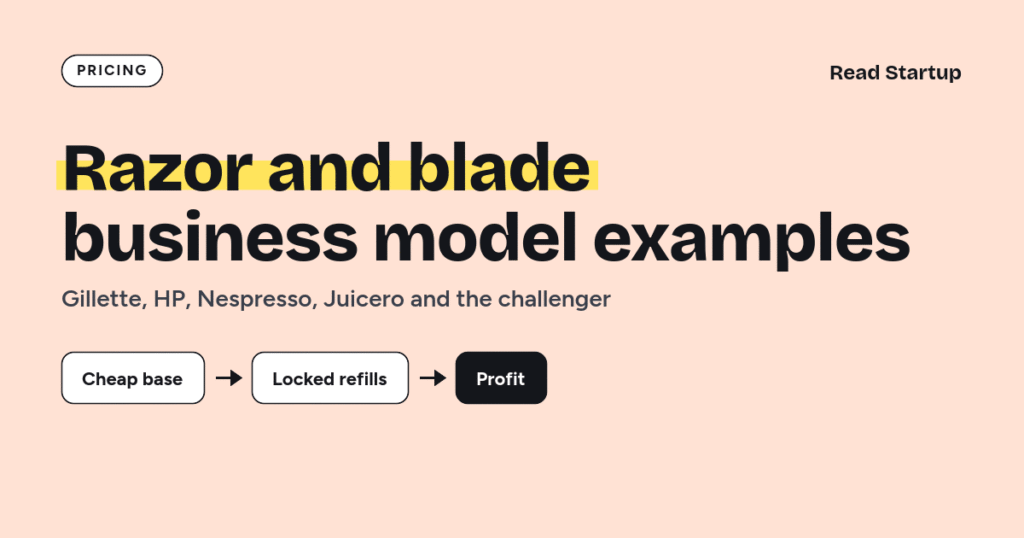
The razor and blade model sells a base product cheaply and earns its profit on the refills customers keep buying. HP and Nespresso refined it, Juicero failed at it, and Dollar Shave Club built a business by attacking it.
This page is part of Read Startup’s pricing case studies and one of the types of pricing strategies. It covers the lock-in that holds the model together, five real companies, and how challengers break it.
What is the razor and blade model?
The razor and blade model sells a durable base product at low or no margin and makes profit on repeat purchases of consumables that only fit it. It works when customers keep buying refills and rivals cannot easily sell compatible ones.
The base product is the entry ticket; the refills are the business. A printer, a coffee machine or a razor handle is sold once, but the ink, capsules or blades are bought for years. That makes the model a bet on two things: that customers will keep refilling, and that they will keep buying your refills rather than someone else’s.
How does the razor and blade model work?
Profit comes from the stream of refills, so the model depends on lock-in through patents, chips or formats, on how often customers refill, and on how long the base product lasts. Overpriced refills breed resentment.
- Lock-in: patents, cartridges, chips. Lock-in is what stops a rival selling cheaper refills. It can be a patent on the blade fit, a chip in an ink cartridge or a proprietary capsule shape.
- Refill frequency and lifetime value. The more often customers refill, and the longer the base product lasts, the more each base unit is worth.
- Base product subsidy and payback. If the base product is sold below cost, the company needs to know how many refills it takes to earn the subsidy back, and how many customers get there.
- Customer resentment when refills feel overpriced. When customers notice that refills cost more over time than the product itself, the markup becomes the opening a challenger needs.
Which companies used the razor and blade model?
Gillette and HP show the classic model, Nespresso applied it to capsules, Juicero failed because its packs could be squeezed by hand, and Dollar Shave Club won by attacking blade prices with a subscription.
| Company | Base product | Refill | Lock-in | Outcome | Source |
|---|---|---|---|---|---|
| Gillette | Razor handle | Blades | Blade patents and fit | Model’s namesake; early history disputed | Picker, U. Chicago Law Review (2011) |
| HP | Printer | Ink cartridges | Cartridge chips | Long-running ink business | Company model |
| Nespresso | Coffee machine | Capsules | Capsule format and patents | Opened to compatible capsules as patents lapsed | Company model, press |
| Juicero | $699 press (cut to $399) | Juice packs | Press that only took its packs | Shut September 2017 | Bloomberg, April 2017; company |
| Dollar Shave Club | Cheap handle | Blades by subscription | Convenience, not patents | Challenger; bought by Unilever, 2016 | Press |
Gillette: cheap handles, profitable blades (and the historical dispute)
Gillette is the company the model is named after, but the popular story, that King Gillette gave away handles from the start to sell blades, is disputed. Law professor Randal C. Picker, in “The Razors-and-Blades Myth(s)” (University of Chicago Law Review, 2011), found that Gillette sold its early razors at high prices while its patents were in force, and cheap handles became common only after the patents expired. The model is real; the origin story is tidier than the record.
HP: printers near cost, ink as the profit
HP’s home printers are the best-known modern case. The printer is priced to get into the home; the ink cartridges, which carry chips that check they are genuine, are where the money is made. The lock-in is technical, and HP’s fights with third-party cartridge makers show how much the model depends on it.
Nespresso: machines that only take its capsules
Nestlé’s Nespresso sells machines that only take its own capsule shape, then sells the capsules. It added a premium brand and its own boutiques on top, so the refills felt like a product, not a tax. As key capsule patents lapsed, rivals began selling compatible capsules, which is the model’s main weak point.
Juicero: a press for packs you could squeeze by hand
Juicero launched a Wi-Fi juice press at $699 in 2016, later cut to $399, that only worked with its own juice packs. In April 2017 Bloomberg showed the packs could be squeezed by hand about as well as by the machine. The lock-in was the press, and the press turned out to be optional. Juicero shut down in September 2017. Testing that first is the job of minimum viable product examples. Read the full Juicero breakdown.
Dollar Shave Club: a subscription that attacked blade prices
Dollar Shave Club launched in March 2012 with a viral video that mocked the price of branded blades and sold cheap blades by monthly subscription. It did not need patents: its lock-in was convenience. Unilever bought the company in 2016. Read the full Dollar Shave Club breakdown.
When does the razor and blade model fail?
The model fails when lock-in breaks through patent expiry or third-party refills, when customers see the refills as the real price, or when the base product solves no real problem, as with Juicero.
- Patent expiry. Once the patent on the fit expires, anyone can make refills, and the margin moves to whoever sells them cheapest.
- Third-party refills. Compatible cartridges and capsules undercut the original even before patents lapse, if the lock-in is weak.
- Customers realise refills are the real price. When the lifetime cost of refills becomes the story, the cheap base product stops looking like a deal.
- A base product nobody needs. If the refill works without the device, the device has no reason to exist.
How do challengers break a razor and blade model?
Challengers expose the refill markup, sell the refill directly at a visibly lower price, deliver it by subscription and make switching easy. Dollar Shave Club did this to Gillette; compatible ink and capsules follow the same playbook.
- Expose the refill markup. Dollar Shave Club’s March 2012 launch video made the price of branded blades the joke.
- Sell the refill directly. Selling online cuts out the retailer margin that keeps incumbent refills expensive.
- Deliver by subscription. Monthly delivery replaces the incumbent’s lock-in with convenience.
- Make switching easy. A cheap starter handle or a machine-compatible capsule removes the cost of leaving.
This is the standard playbook for DTC brands attacking incumbents that earn on refills.
How can you use the razor and blade model?
Make sure customers value the refill, protect compatibility legitimately, price refills so resentment does not invite a challenger, and track refill attach rate for every base unit sold.
- Make sure customers value the refill. The refill must do something customers want, not just something the device requires.
- Protect compatibility legitimately. Patents, design and quality hold up better than tricks that block rivals.
- Price refills below resentment level. The higher the markup, the bigger the opening for a challenger.
- Track refill attach rate. Refill attach rate is the share of base units sold that go on to generate refill purchases. A base unit with no refills is a pure loss.
Frequently asked questions about the razor and blade model
What is the razor and blade business model?
The razor and blade business model sells a base product cheaply and makes its profit on refills or consumables that only fit that product. Printers and ink, coffee machines and capsules, and razor handles and blades are the common examples.
Does Gillette still use the razor and blade model?
Gillette still earns mainly on replacement cartridges rather than handles, so the model holds in broad terms. Its early history is disputed, though: Picker (2011) found early Gillette razors were sold at high prices while patents held.
Why are printer ink cartridges so expensive?
Printer makers often price printers low and earn on ink, so cartridges carry the margin. Chips and patents make it harder for cheaper compatible cartridges to work, which keeps the price up.
What is the reverse razor and blade model?
It flips the model: the company profits on the device and sells content or refills cheaply. Apple did this with the iPod, earning on the hardware while selling iTunes songs at low prices.
Is the razor and blade model a loss leader?
They are related but different. Loss leader pricing sells one item cheaply to bring customers in for one profitable visit; the razor and blade model adds lock-in, so the customer keeps coming back for refills only you can sell.
If your model depends on refills, measure attach rate and ask what a challenger would say about your refill price. See how others did it in our pricing case studies, or get one company decision broken down twice a week.
By the Readstartup Team. Figures are attributed to their source and dated; corrections are logged on our Corrections Policy page.
More guides
Transparent Pricing Examples: Companies That Won by Exposing Hidden Fees
Transparent pricing examples from Wise, Southwest Airlines and Costco: how showing the real price beat rivals who relied on hidden fees, and what it…
Premium Pricing Examples
Premium pricing examples from Hermès, Apple, Liquid Death and Patagonia: how brands hold high prices permanently, and what keeps a premium from collapsing into…
Decoy Pricing Examples
Decoy pricing examples from The Economist experiment, cup sizes, popcorn and SaaS pricing pages: how a third option steers choice, and how to tell…