Wise built its brand on exposing the fee its industry hides. Why publishing your price only works once you have a real cost advantage.
Kristo Käärmann and Taavet Hinrikus built a spreadsheet before they built a company. One was paid in euros and needed pounds. The other was paid in pounds and needed euros. They swapped at the mid-market rate and cut their banks out of the loop.
The saving was real. The discovery was bigger. Neither of them had known what the bank was charging, because the charge was buried inside the exchange rate.
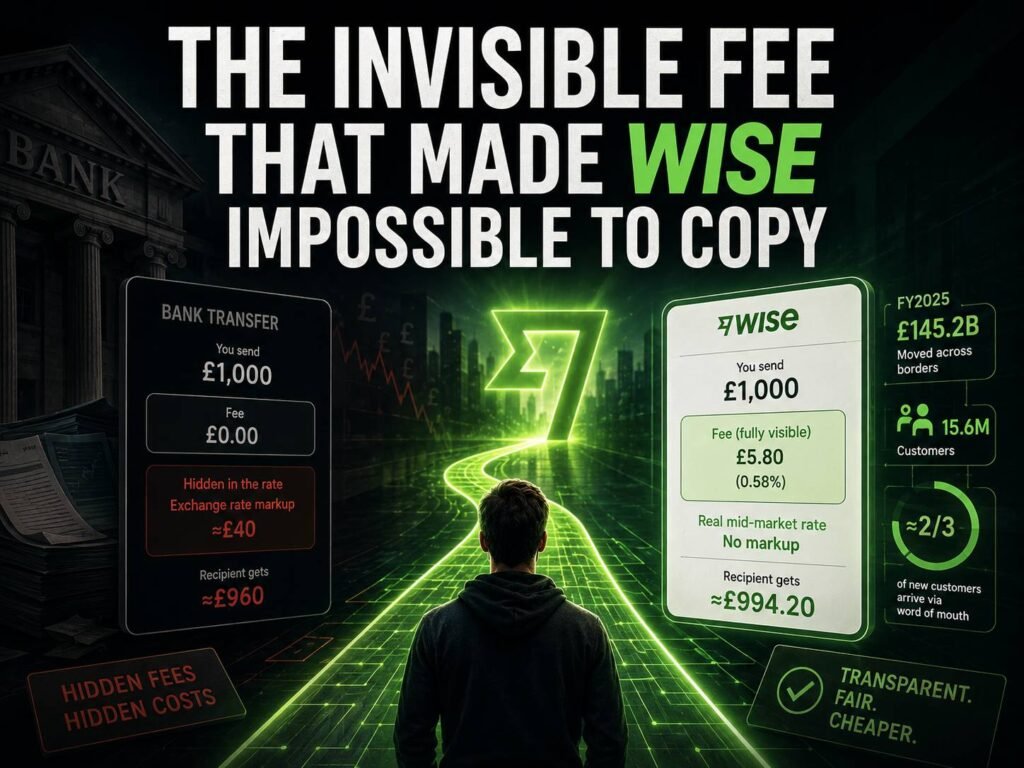
Wise turned one piece of hidden information into a product, a positioning statement, a public KPI, and eventually a lobbying campaign. In FY2025 it moved £145.2 billion across borders for 15.6 million customers.
The category's biggest fee was invisible
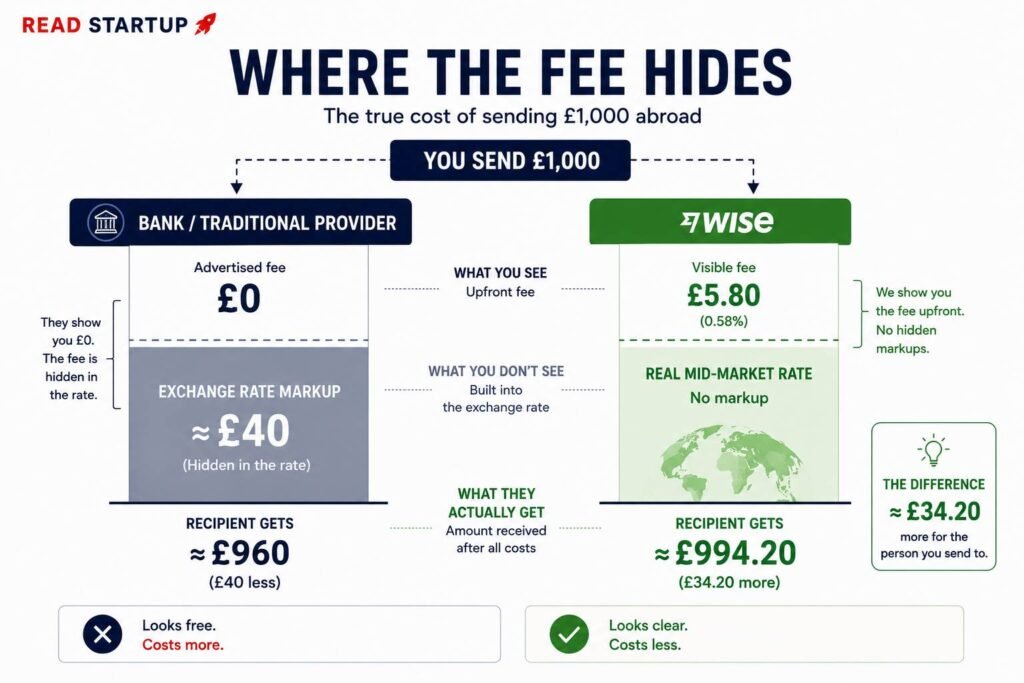
Banks and brokers advertised "0% commission" and "no transfer fees" while quietly marking up the exchange rate. Someone sending £1,000 could see a fee of zero and still lose £40.
This produced a market where price competition was structurally impossible. Nobody shops on price when the price is not displayed.
Wise's founding move was to make the number visible. Charging a stated percentage on top of the real mid-market rate looked more expensive than "free" and came out dramatically cheaper in practice.
Competitor pricing became the ad unit
Wise's homepage runs a live calculator showing what the recipient actually receives, then runs the same transfer through banks and rivals in a comparison table.
Publishing your competitors' prices is only rational when you win on price every time. That constraint does useful work internally. The table is a permanent public commitment to stay the cheapest, and it kills any temptation to quietly widen the spread when a quarterly target gets tight.
The conversion effect is direct. A visitor who arrived undecided leaves having done the comparison shopping already, on Wise's site, in Wise's framing.
A price cut is the marketing budget
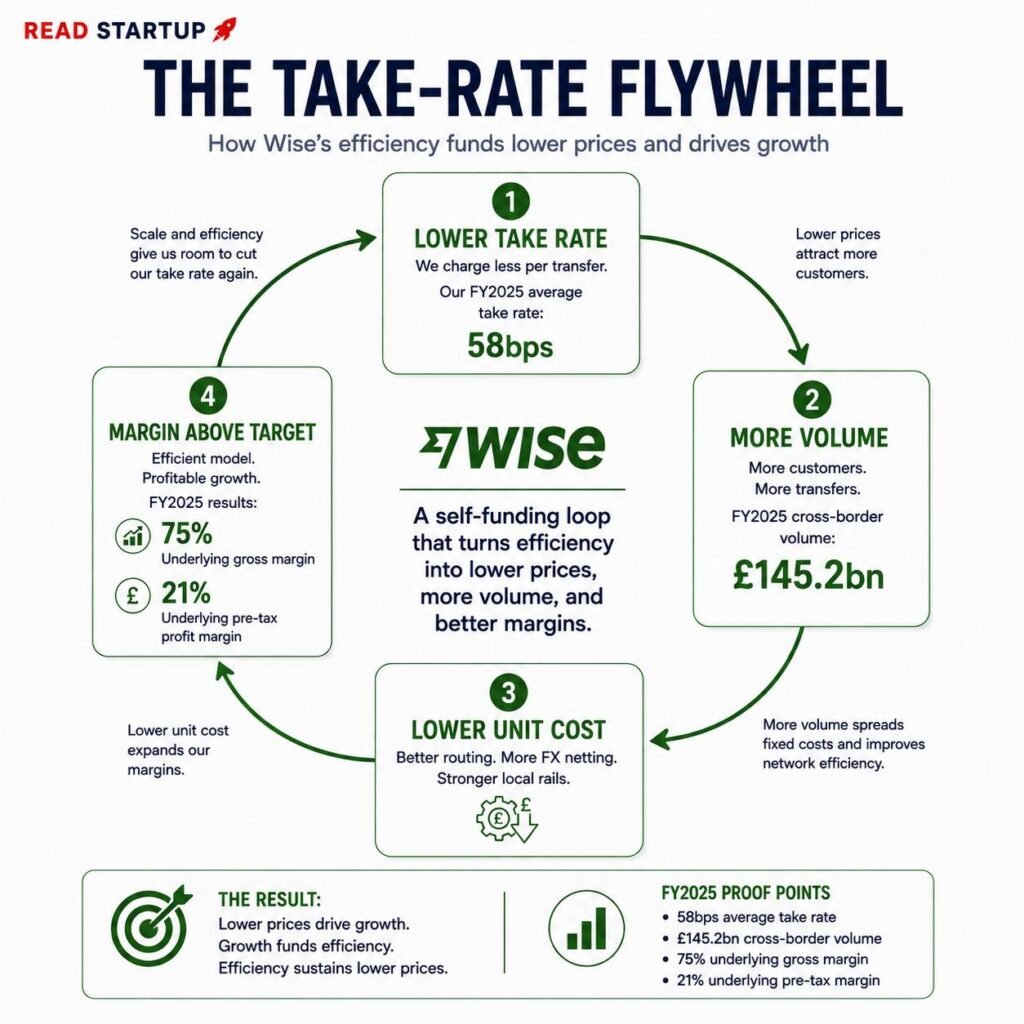
Wise publishes its own take rate every quarter and treats a falling number as good news. In FY2025 the average cross-border take rate
fell 9 basis points to 58bps, with Q4 coming in at 53bps.
Run 9 basis points against £145.2 billion of cross-border volume, and the reduction works out to roughly £130 million of revenue Wise chose not to collect in a single year.
A comparable fintech would book that number as a marketing budget and spend it on performance ads. Wise routes it through the price line, and the payoff shows up in acquisition: around two-thirds of new customers arrive through word of mouth, a figure the company has reported consistently for years.
The flywheel runs on efficiency, not on investor money
The cuts only work because scale pays for them. Wise's underlying gross profit margin was 75% in FY2025, and its underlying pre-tax profit margin came in at 21%, above the 13% to 16% band the company targets.
Being too profitable becomes the trigger for the next price cut. Lower prices pull volume, volume lowers unit cost through better payment routing and bigger FX netting, and the saving funds the following cut.
Compare that with a discount funded by venture money, which reverses the moment the round runs dry. Customers can feel which kind they are getting, and they refer accordingly.
Banks cannot copy this without cannibalising themselves
The FX spread is a profit center for a bank. Matching Wise means deleting a revenue line that pays for branches and staff.
Wise carries no such conflict, which is why the transparency position is defensible in a way that features and app design are not. Any competitor can copy a calculator screen. Very few can copy a willingness to earn less per transaction.
Founders should hunt for exactly this shape: a position that is cheap for you to hold and expensive for the incumbent to match.
Lobbying is a distribution channel
Wise campaigns for mandatory upfront disclosure of exchange rate markups. Its annual G20 report estimated that
customers would lose $274 billion to hidden FX fees during 2025. In the UK it ran a petition arguing that
small businesses lost £2.8 billion to hidden fees in a year because of a transparency loophole.
The commercial logic is clean. If regulators force every provider to display total cost upfront, comparison becomes default customer behavior, and the cheapest operator takes share without buying a single impression.
Policy work is slow and unglamorous. For a genuine low-cost operator, it is also the highest-leverage distribution investment on the table.
Takeaways you can use this week
If you are a founder, here are a few things you can learn from Wise:
- Find the fee your category hides. Whatever sits in your industry's fine print is your positioning wedge. Name it, quantify it, and build your homepage around it.
- Publish one number you want to be judged on. Pick the metric your customers actually care about and report it on a fixed schedule. The public commitment is the point.
- Price a price cut like an ad buy. Multiply the reduction by your volume, set it against your paid CAC, and see which one buys more customers.
- Only publish a comparison you won on your worst day. Run it against your least competitive segment and your weakest route before it goes live.
- Earn the cost advantage first. Wise built direct payment system access and local payout rails before it made cheapness the brand. Transparency marketing without a structural cost edge just hands prospects a shopping list.
More breakdowns
Nintendo Wii Won with Weaker Hardware on Purpose
The weakest box of its generation outsold both rivals and made money from day one

How Costco Earns Before You Walk In
The most profitable product in every warehouse is a plastic card at the door

The Thin Margins Behind Every Pathao Ride
The ride that fit Dhaka perfectly was never where the profit lived