Why Microsoft Office and Amazon Prime won by bundling while Netflix, Spotify and Canva won by unbundling, and when each strategy works.
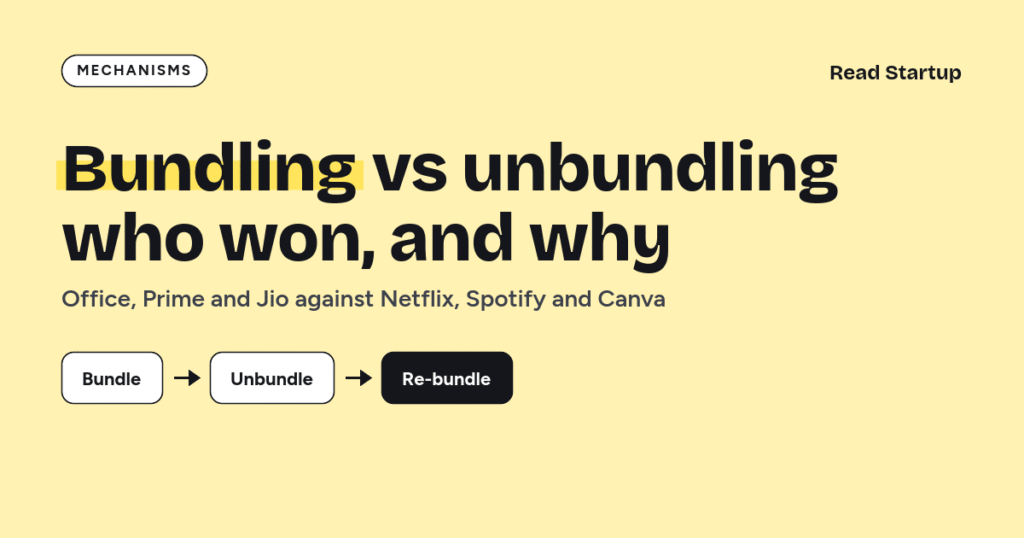
Microsoft Office and Amazon Prime won by bundling; Netflix, Spotify and Canva won by pulling one job out of a bigger bundle and doing it better. Which one works comes down to marginal cost, how unevenly customers value each part, and who controls the customer.
This is one of Read Startup’s business mechanisms deep-dives, looked at from both directions. For the pricing side, see our bundle pricing examples.
What is the difference between bundling and unbundling?
Bundling sells several products together for one price; unbundling pulls one product out of a bundle so customers pay only for the part they want, usually done better or cheaper.
The two are not opposites in the sense that one is right. They are moves in the same game. A bundle wins when customers would rather pay once for many things; an unbundler wins when enough customers are paying for things they never use. Most industries swing between the two over time: cable bundled channels, streaming unbundled them, and streaming services are now bundling again.
Which companies won by bundling?
Microsoft Office beat stronger standalone apps by selling them together, Amazon Prime made leaving costly by adding video to free shipping, and Jio packaged data, calls and apps into one cheap plan.
Microsoft Office
Word, Excel and PowerPoint were not each the clear leader when they were first sold together. The suite won because buyers who needed two or three tools could get all of them for close to the price of one, and adding one more program to the box cost Microsoft very little. Condition that made it work: near-zero marginal cost and customers who needed several tools.
Amazon Prime
Prime started in 2005 as a fast-shipping membership. Adding video and other perks to the same fee meant a member who stopped caring about shipping still had a reason to stay. Each new perk raised the cost of leaving. Condition that made it work: customers valued the parts very differently, so one fee captured more of what each would pay.
Reliance Jio
When Jio launched in India in 2016, incumbents charged separately for voice calls and data. Jio sold data, calls and its own apps in one cheap plan, which was simpler to understand and hard to match. Read how Jio rewired a billion-person market. Condition that made it work: a new network with spare capacity, so adding calls and apps cost little.
Which companies won by unbundling?
Netflix pulled TV and films out of the cable package, Spotify let people play single songs instead of buying albums, and Canva offered simple design without a professional design suite.
Netflix
Cable sold hundreds of channels for one monthly bill, whether you watched them or not. Netflix sold one thing, on-demand viewing, over the internet, which meant it did not need the cable company to reach customers. Condition that made it work: the internet let it bypass the incumbent’s distribution.
Spotify
The album bundled a few songs people wanted with many they did not. Piracy had already unbundled music illegally; Spotify offered the same single-song access legally, by streaming. Read how Spotify beat piracy. Condition that made it work: customers were already refusing to pay for the whole album.
Canva
Professional design suites bundle hundreds of powerful tools. Most people who need a poster or a social post use a handful. Canva sold just that handful, simply and in the browser, to a far larger group than professional designers. Read how Canva beat Adobe. Condition that made it work: customers were over-served and overpaying.
Note that winners often re-bundle later: Spotify has added podcasts and audiobooks, and Netflix has added games.
When should a company bundle, and when should it unbundle?
Bundle when adding a product costs little and customers value the parts differently; unbundle when customers are overpaying for parts they do not use, or when you can reach them without the incumbent’s distribution.
| Condition | Favours | Example |
|---|---|---|
| Near-zero marginal cost of adding a product | Bundle | Microsoft Office |
| Customers value the parts very differently | Bundle | Amazon Prime |
| Customers are over-served and overpaying | Unbundle | Canva |
| The incumbent controls distribution you can bypass | Unbundle | Netflix |
| Customers already refuse to pay for the whole bundle | Unbundle | Spotify |
If you are the incumbent, the table is a warning list. If you are the challenger, it is a target list. The same company can be on both sides: Netflix unbundled cable and now bundles its own catalogue for one fee.
Frequently asked questions about bundling and unbundling
Why do companies bundle products?
Companies bundle to capture more of what customers will pay, raise the amount each customer spends and make it harder for single-product rivals to compete. It works best when adding a product costs little and customers value the parts differently.
What is an example of unbundling?
Canva unbundled simple design from professional design suites, giving people the few tools they needed without paying for the rest. Netflix pulling TV and films out of cable packages is another.
Do unbundlers end up re-bundling?
Often, yes. Once an unbundler has the customer, adding more to the same subscription raises retention. Spotify added podcasts and audiobooks; Netflix added games. The cycle then opens the door to the next unbundler.
Before you choose, check the table: what adding a product costs you, how differently customers value the parts, and who controls the customer. For the numbers behind bundles, read our bundle pricing examples, or get one company decision broken down twice a week.
By the Readstartup Team. Corrections are logged on our Corrections Policy page.
More guides
Transparent Pricing Examples: Companies That Won by Exposing Hidden Fees
Transparent pricing examples from Wise, Southwest Airlines and Costco: how showing the real price beat rivals who relied on hidden fees, and what it…
Premium Pricing Examples
Premium pricing examples from Hermès, Apple, Liquid Death and Patagonia: how brands hold high prices permanently, and what keeps a premium from collapsing into…
Decoy Pricing Examples
Decoy pricing examples from The Economist experiment, cup sizes, popcorn and SaaS pricing pages: how a third option steers choice, and how to tell…